


Skopelos myths: Dragons, debauchery and a sexy female pirate
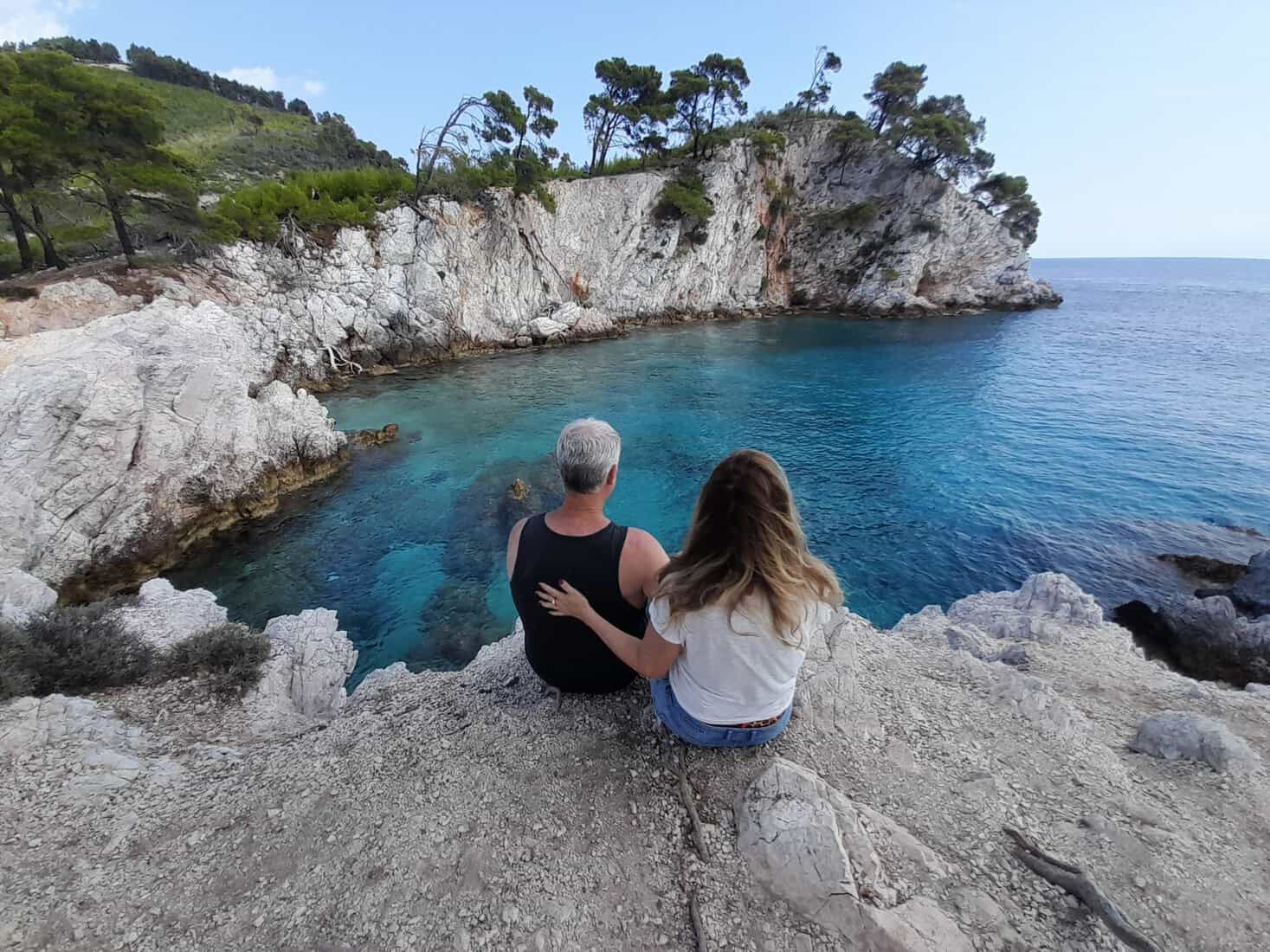
SKOPELOS, Greece – Like many American children, I grew up listening to my mother tell me bedtime stories. But these weren’t about Cat in the Hat or Jack and the Beanstalk. These were violent. These were heroic. These were spellbinding.
These were Greek myths.
Greek mythology became my passion before sports, chocolate and girls. I reveled in the tales of Poseidon ruling the seas, Mercury racing across battlefields and Zeus ruling over it all, thunderbolt in hand.
I knew they weren’t real. But then I took a Bible Lit class in junior high and realized the Bible’s tales weren’t any more believable than the Greek myths Mom told. I’ve been an atheist ever since.
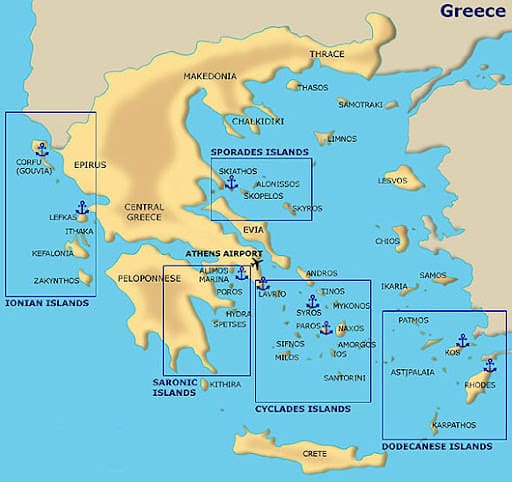
Until I moved to Italy the first time in 2001, Greece was my favorite country. The myths lured me but the ouzo, the cuisine, the beaches seduced me. Then 10 years ago I discovered Skopelos. This little isle of 4,500 people (and no airport) in the northern Aegean Sea became my go-to summer retreat six times.
I’ve written a lot about the greenest island in Greece. From film sites for Mamna Mia! to a famous miniature shipbuilder to the birthplace of Greek blues called Rebetiko, I thought I squeezed every ounce of interest from this forest-covered, beach-lined paradise.
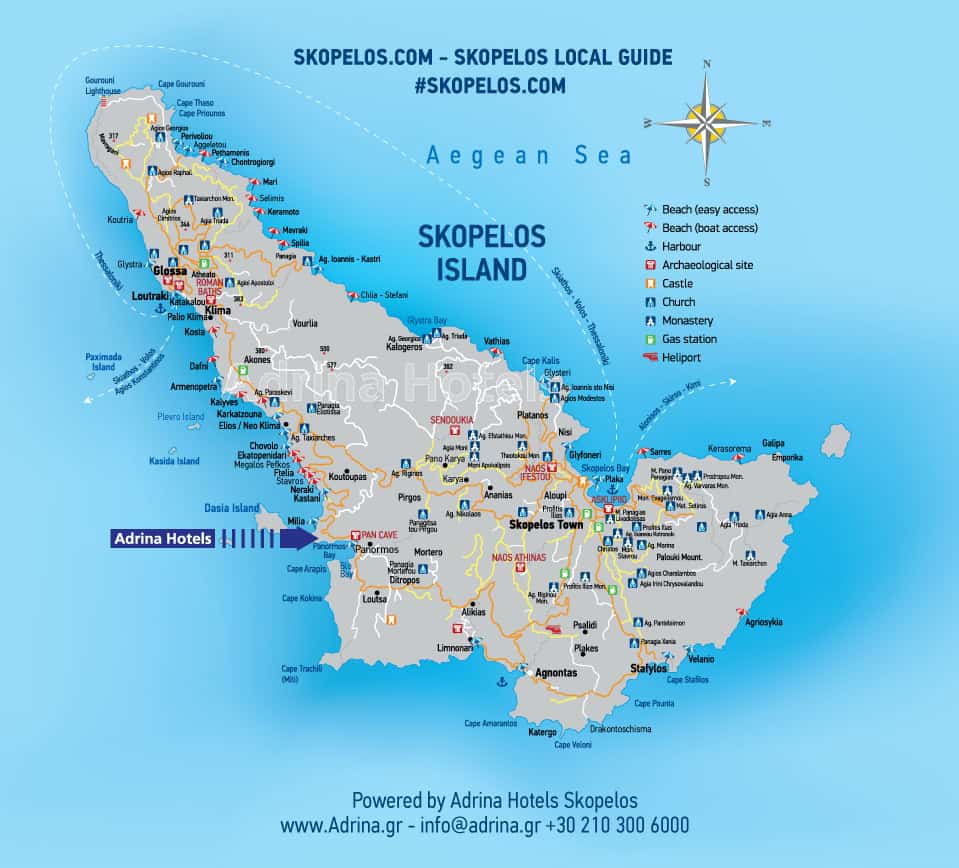
So before Marina and I took our annual trip two weeks ago, I asked our learned manager of our stupendous Panormos Beach Hotel, Angelos Falkos, if he had a story idea, his answer made me jump with delight.
Skopelos myths.
Man-eating dragons. Gods of wine and debauchery. Sexy female pirates. I could listen to these stories all day. Instead, we explored them. Skopelos is only 37 square miles (96 square kilometers), about the size of my old stomping grounds of Boulder, Colo.
Yet Skopelos is littered with sites where myths lay dormant.
Skopelos was a base for Barbarossa, the famous 16th century Ottoman pirate who hid his treasure on the island which was a major trade center in the Aegean. Barbarossa killed many and myths such as bad luck and big snakes became connected to the hidden treasure.
“There are many, many stories about the island,” said Angelos, whose father, Anastasios, is a Skopelos native. “To start, of course, we go back to the years when there was no electricity on the island. So the people connected shadows from the candles with some myths, fairy tales and so on. Now we call them superstitions or fairy tales.”
Donning our swimsuits and hauling sunscreen, we rented a car and drove into Skopelos’ coves and crannies chasing dragon tails.
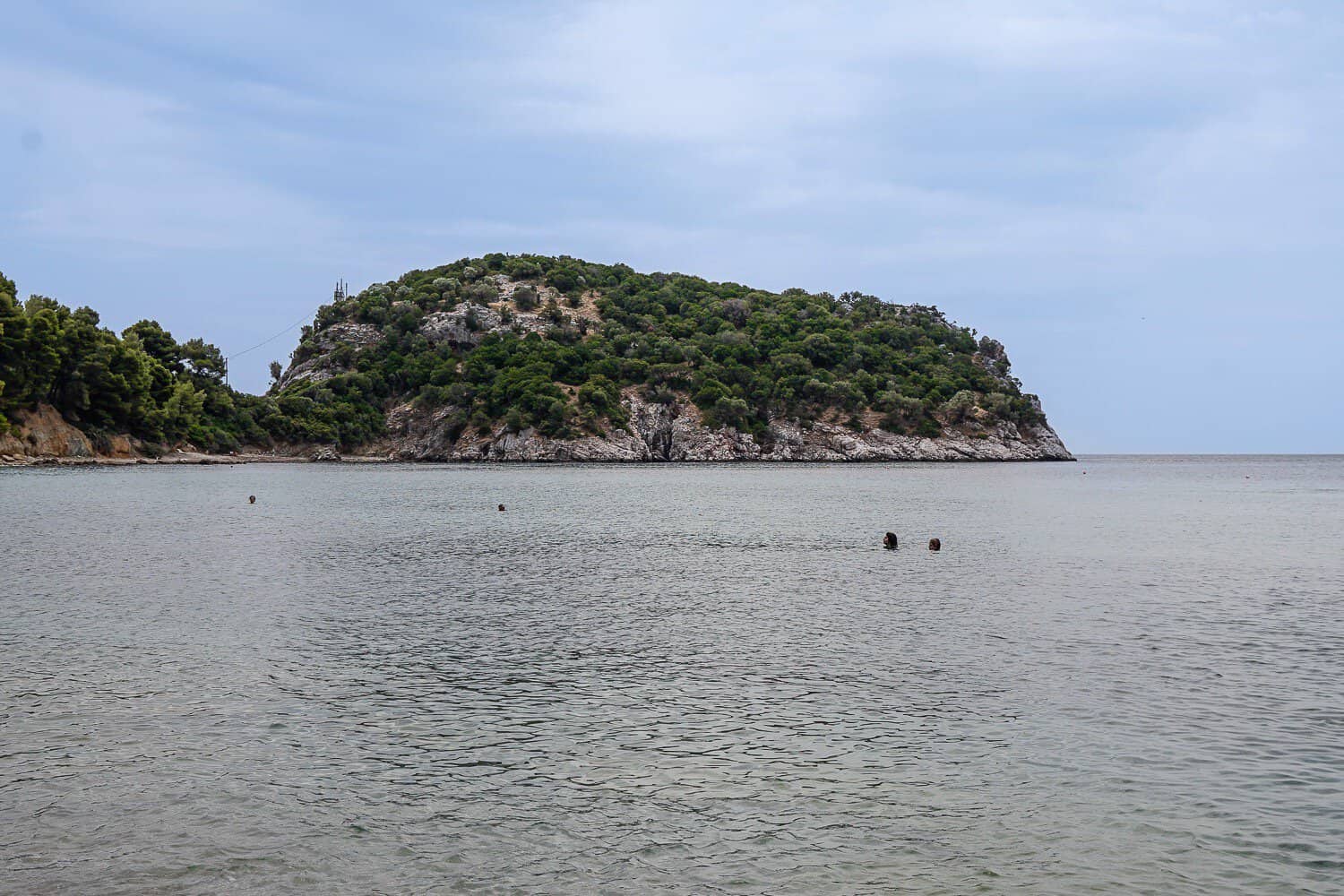
Prince Stafilos
With our two friends from Rome, Paola and Saverio, in tow, our first venture was to find Skopelos’ first settlement. In the 15th century B.C. a man named Stafilos became Skopelos’ first resident. His brother, Peparithos, soon followed. They were also the alleged sons of Dionysus, the god of wine and fertility so you knew the nightlife would be good.
Before he became a Greek hero in Greek mythology, Theseus was sent to Crete as part of a group of youths meant for sacrifice to the Minotaur, the half man half bull. In Crete he met Ariadne who helped him escape Crete but not before he slayed the Minotaur.
On the island of Naxos, Dionysus appeared in Theseus’ dream and told him to leave so he can have Ariadne to himself, no doubt after plying her with wine and vague promises of immortality. Fearing the wrath of gods more than a man with bull horns, Theseus bolted. Dionysus ran off with Ariadne and had four children, including Stafilos and Paparithos.
While Skopelos’ original name was Paparithos, Stafilos became the Prince of Skopelos and archaeological findings suggest he may have actually existed. (I assume they have stopped looking for Minotaur fossils.) In 1936, a tomb was found on the southeast end of Skopelos and a sword inside led archaeologists to believe this was Stafilos grave.
The tomb has since been cleared out, its contents now in the National Archaeological Museum in Athens but we wanted to find Stafilos’ first settlement. We drove from the Magic Cars rental agency in the capital of Skopelos Town to the southeast coast 2 ½ miles (four kilometers) away.
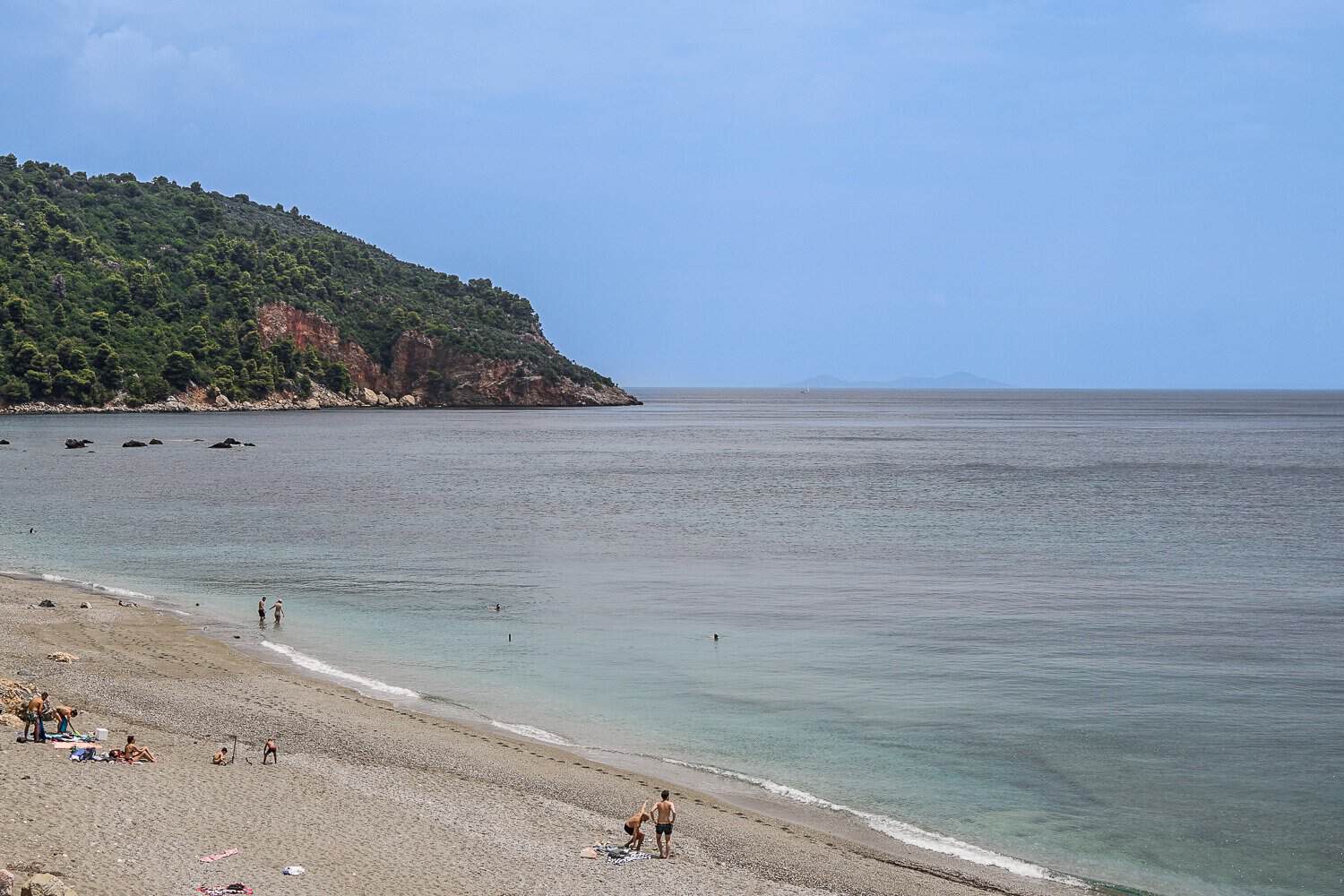
Marina and I had been there before but didn’t know it. During a road tour of the island two years ago, we stopped on a hill and walked down a crude trail to Stafilos Beach. It’s about 200 meters long, gently curved hard against a high cliff.
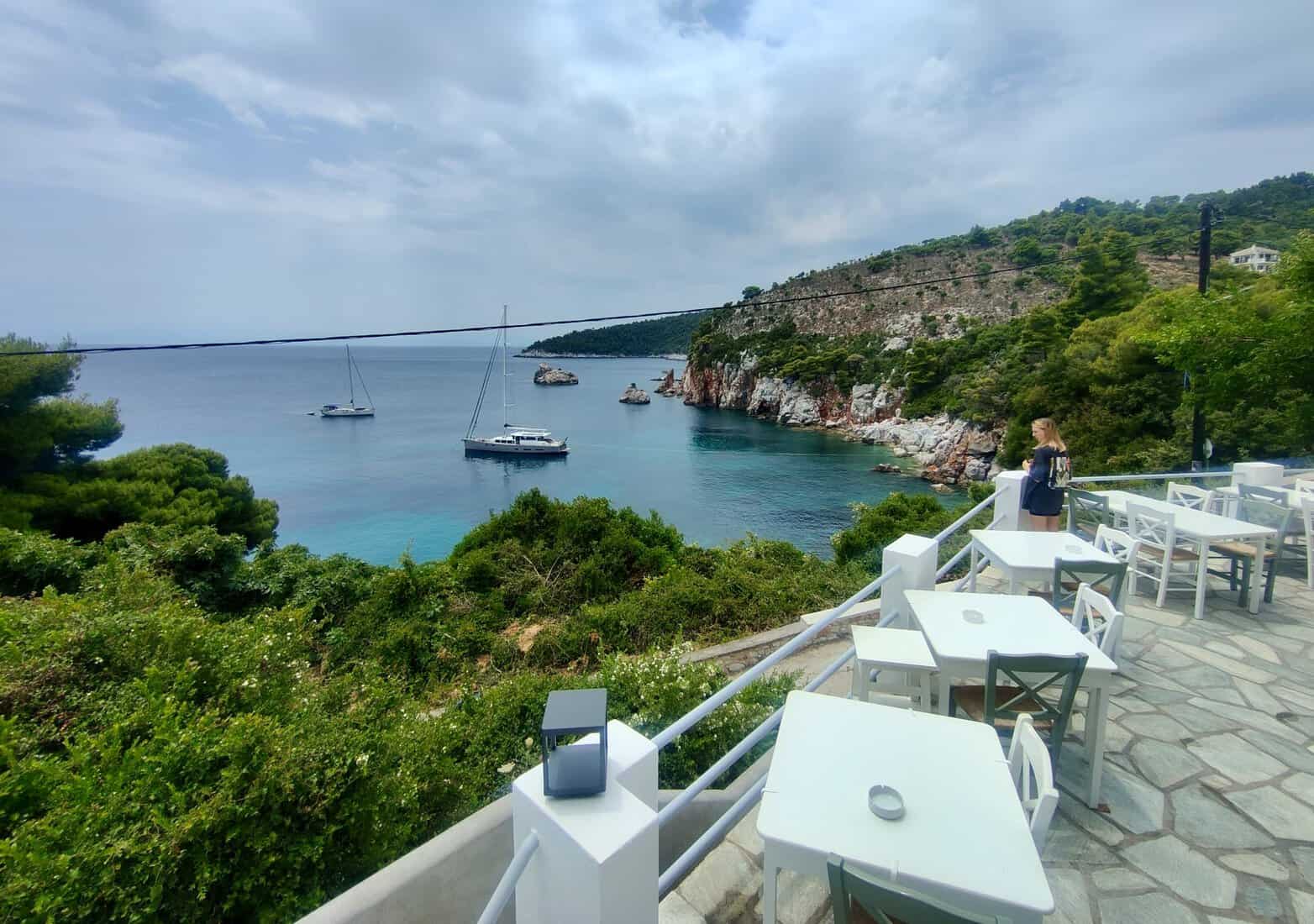
Two weeks ago, four sailboats bobbed offshore in turquoise-green water. A couple dozen sunbathers lounged in postcard-perfect sunny weather in the high 70s.
At the end of the beach was a rocky headland 200 feet high. This is where Stafilos had his first settlement. Today it’s covered in pine forest. A crude foliage-covered trail led to the top but a woman warned us not to try. Two friends had gone up and hadn’t come down, presumably lost.
But we climbed high enough to look down at the other side to Velanio Beach, wider, more remote with fewer people. I can see why Stafilos became a prince.
He knew his real estate.
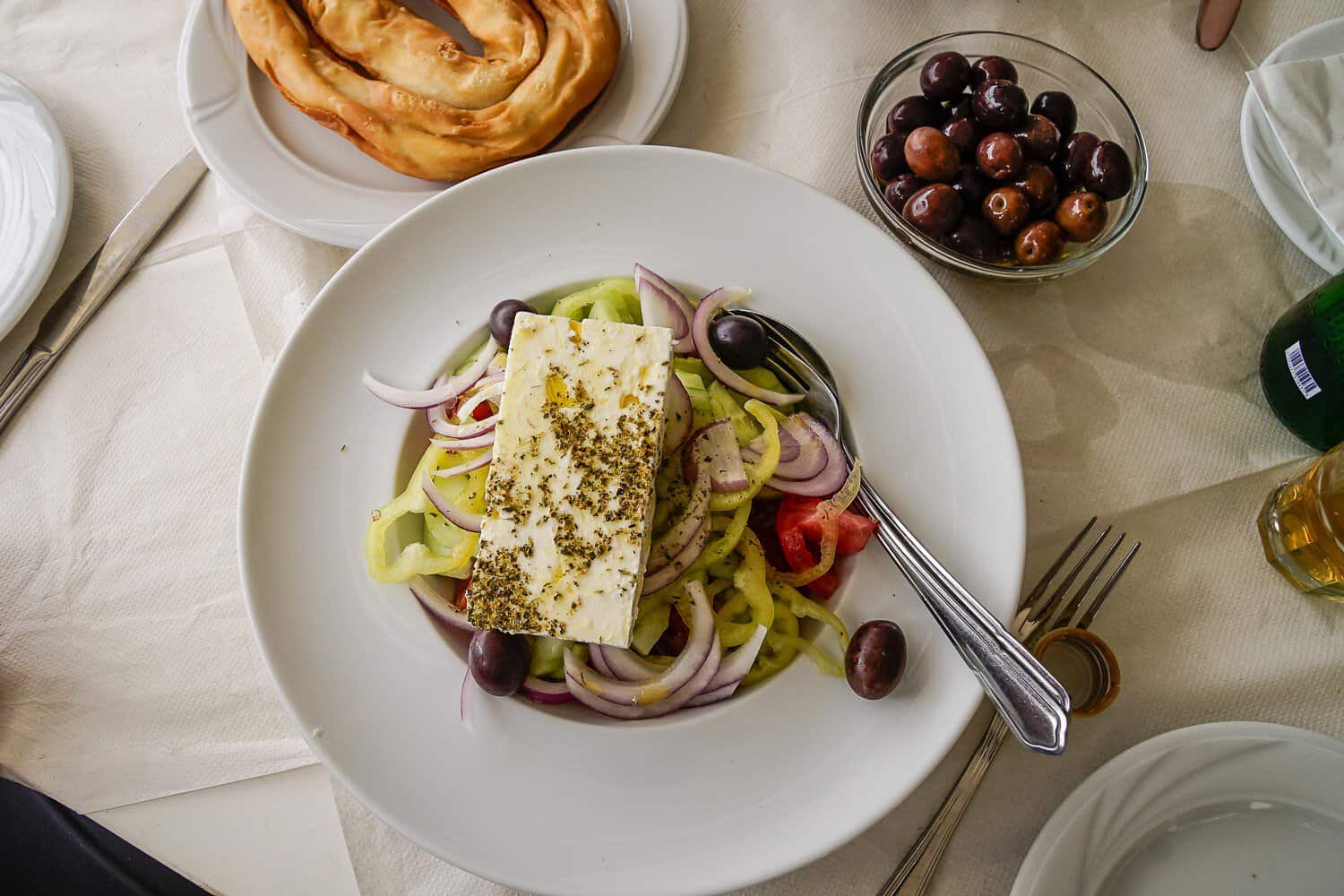
We had lunch again at the appropriately named Stafilos Restaurant where we had Greek salad and Athos beer overlooking sailboats on the blue-green sea.
Drakontoschisma
About 800 years ago, legend tells us, Skopelos suffered its first serious civic problem, yes even more than a shortage of feta.
A dragon kept eating everyone.
While this did lower home prices, everyone still fled. Then came a man named Riginos from the central Greek region of Boeotia accompanying a boatload of convicts sentenced to death by dragon.
According to legend, the only person on the boat the dragon couldn’t eat was old Riginos. The dragon was scared. When they met on the beach not far from Stafilos’ settlement, the dragon threw himself into the sea and died.
Riginos became Skopelos’ patron saint until Feb. 25, 362 A.D. when the Romans tortured him to death during their many Christian non-appreciation days. Feb. 25 remains an island holiday and a monastery not far from the dragon’s death was named Monastery of Saint Riginos.
To reach the dragon’s watery grave, we drove inland and then west up the coast only about a mile to Amarantos Beach. We parked on the side of a hilly road and walked to a lookout point that served as a small parking lot.
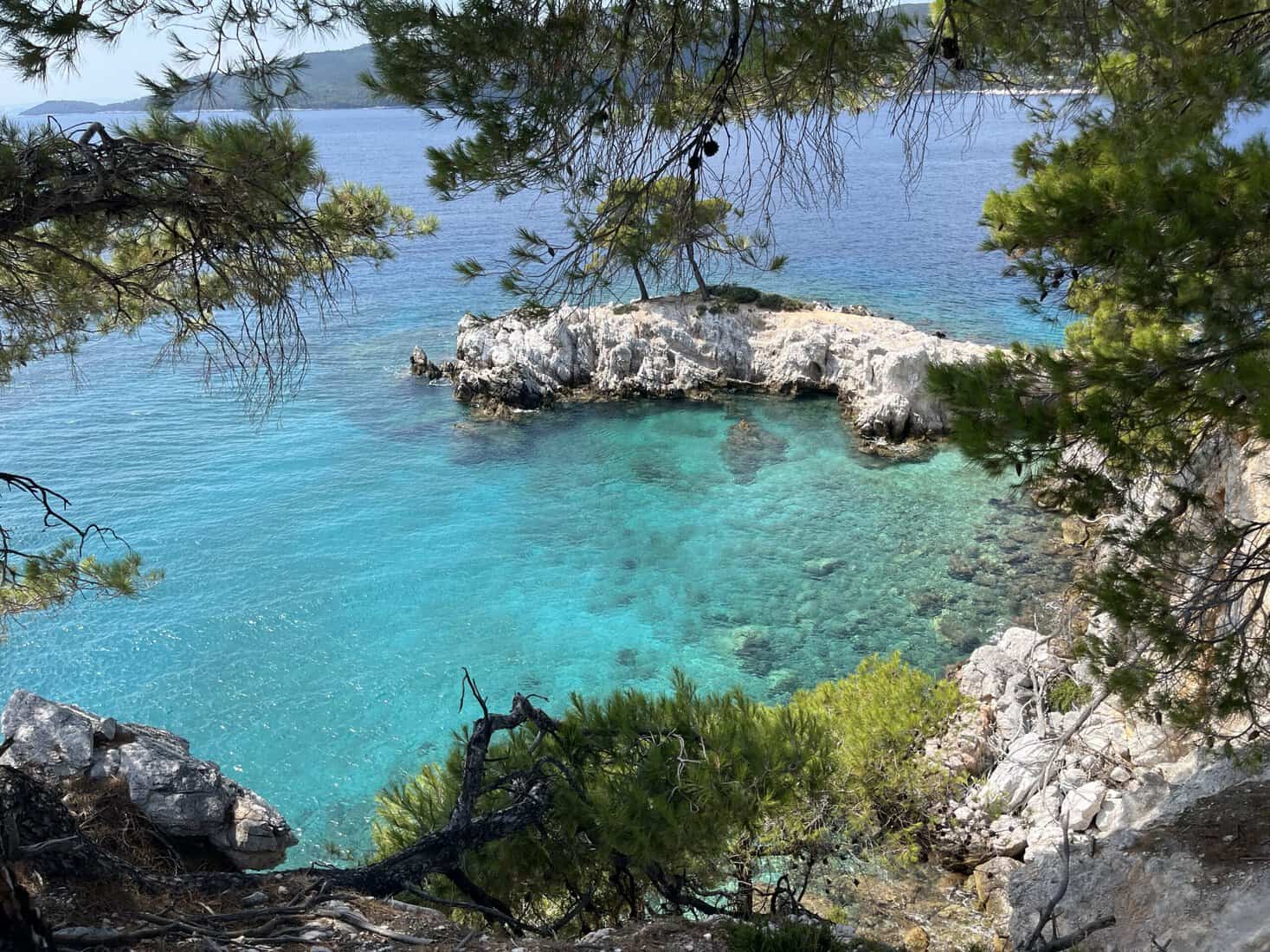
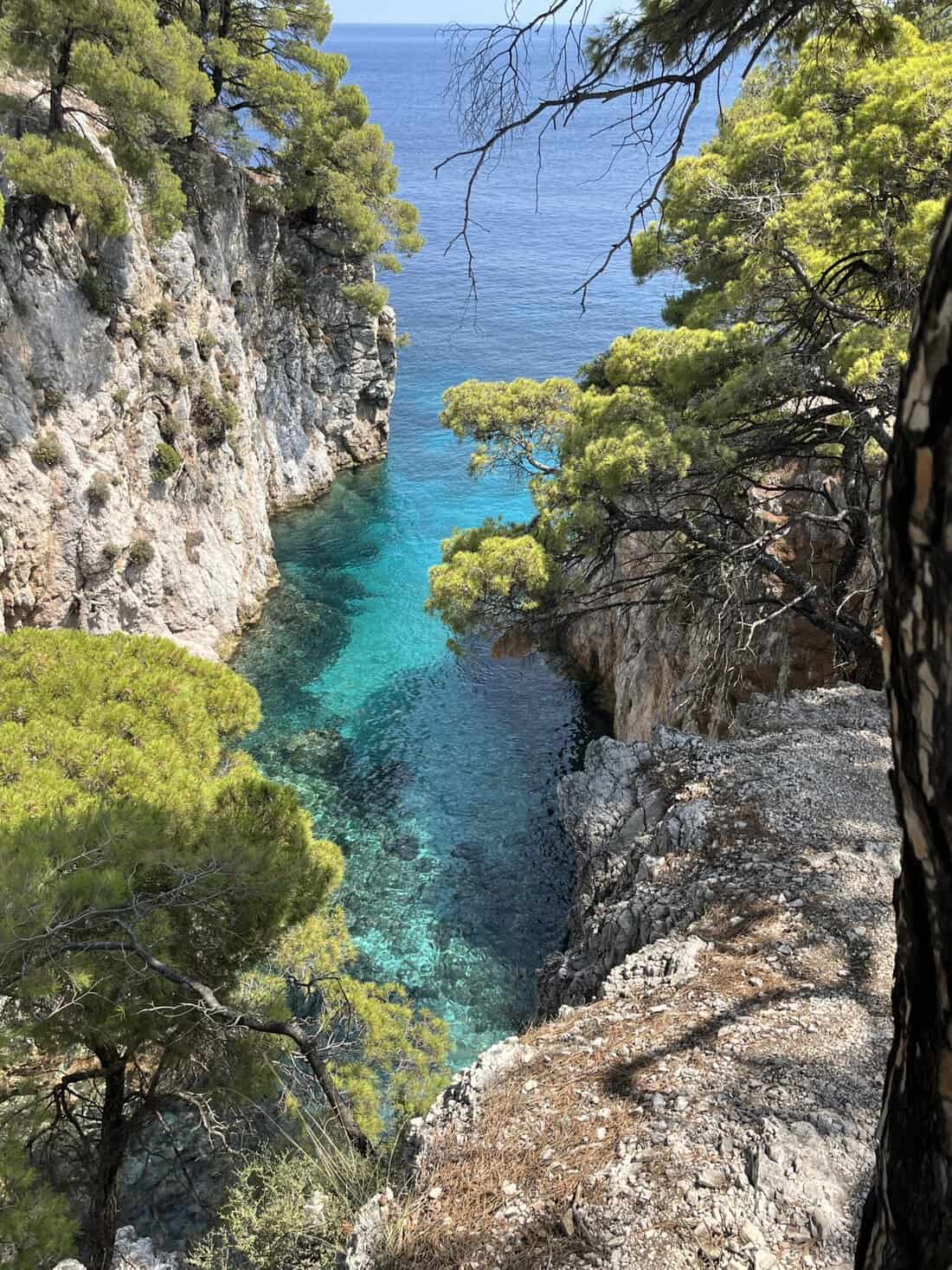
Looking down we saw numerous little coves between high, tree-covered cliffs. Turquoise water right out of the South Pacific provided one of the most stunning views I’ve seen in more than a dozen trips to Greece.
No one knows exactly where the dragon offed himself. But one narrow cove looked as if a god had separated the cliffs to provide the perfect swimming hole – or a private water grave for a dragon who couldn’t swim.
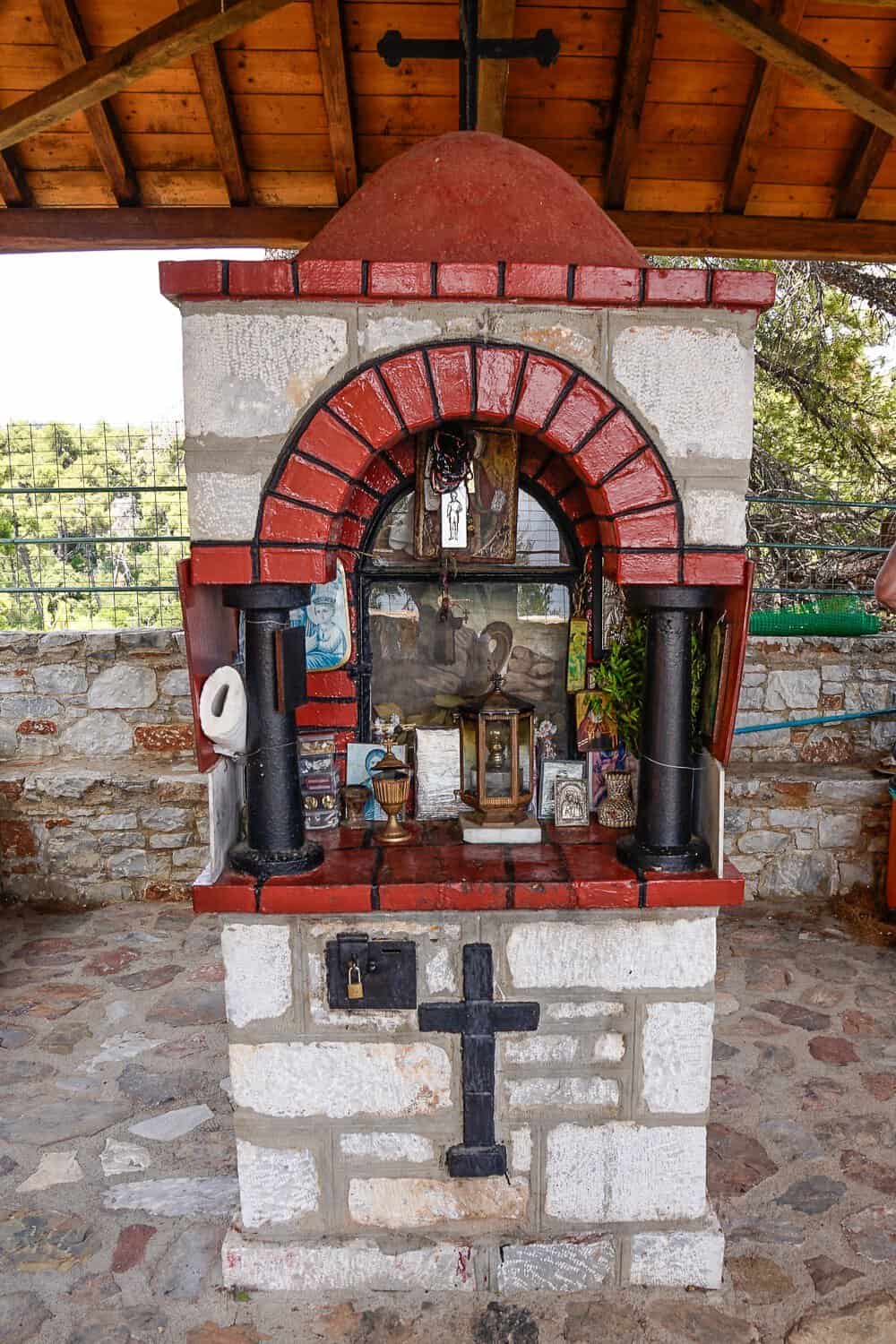
Near the viewpoint was a small stone shrine behind a gate. Figures of Saint Riginos sat on a red mantle. I saw no signs of little dragons.
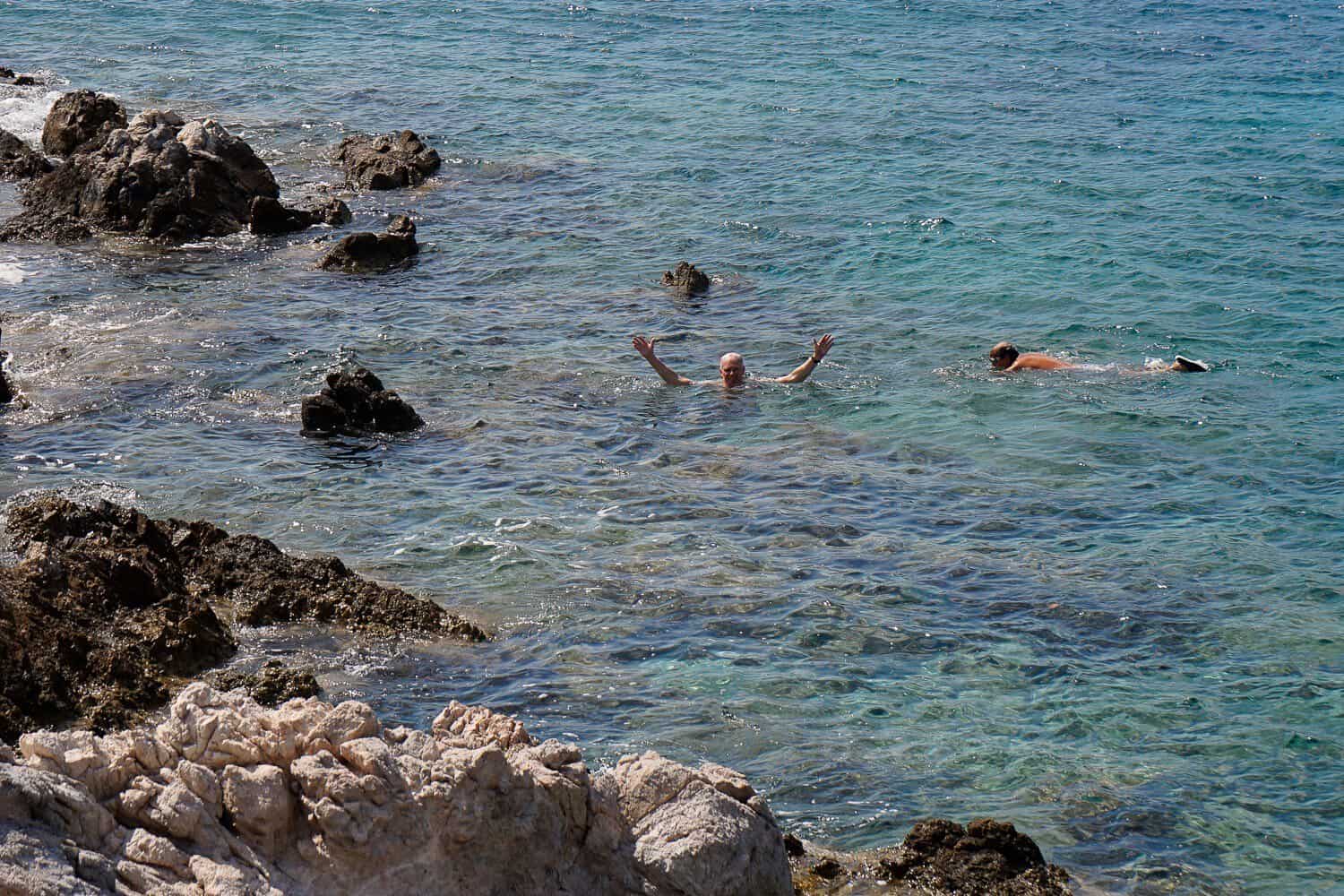
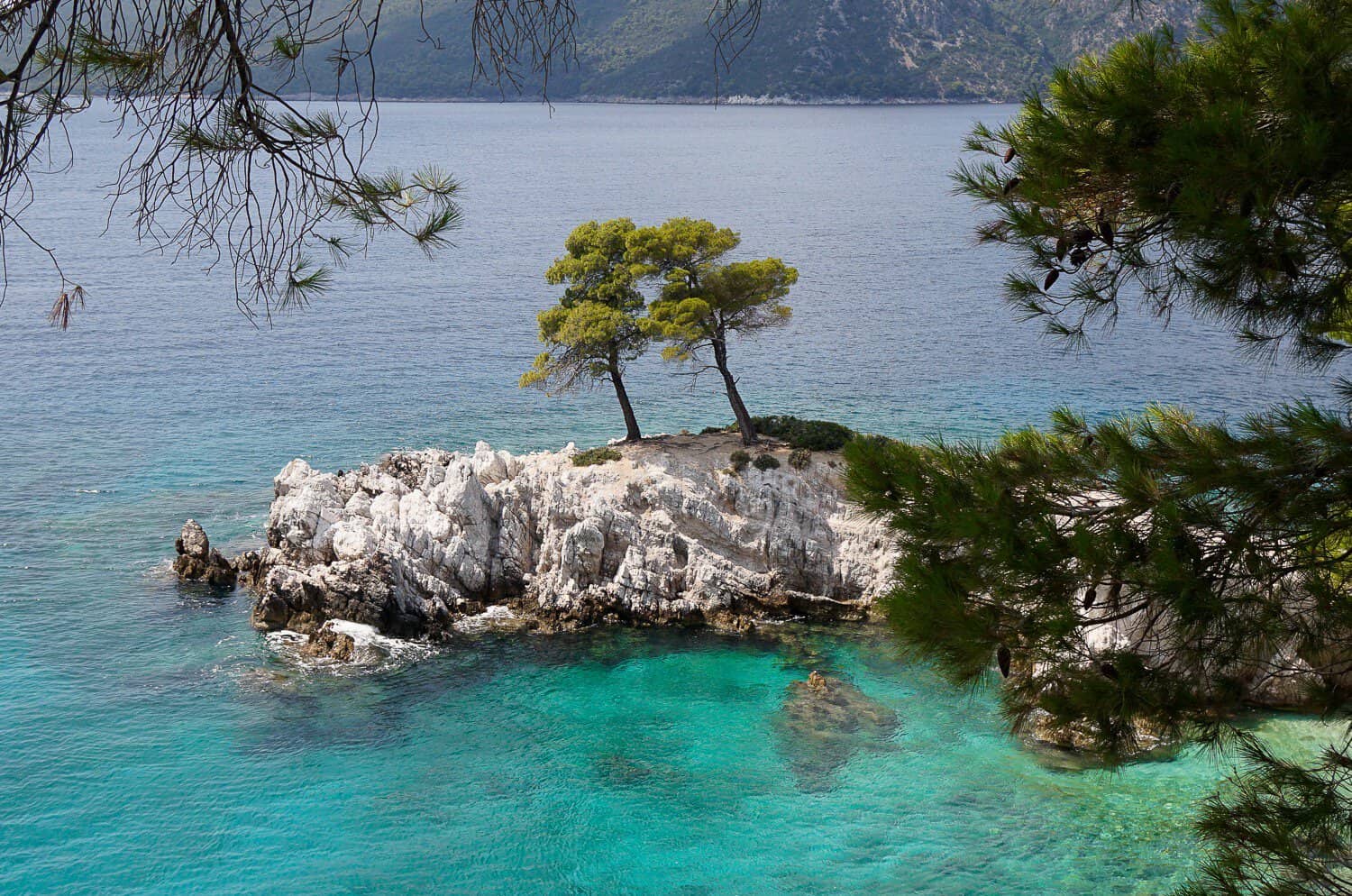
We traversed the thick brush to a rocky outcrop where two twin trees provided shade above the glorious setting surrounded by sea. Saverio and I precariously clambered down the sharp, slippery rocks and slid into the turquoise water. Like in our village of Panormos, the sea was in the high 70s and so clear we could see the bottom deep below.
While the dragon died here, many people would die to be here.

Adrina the sexy pirate
Sometime between the 8th and 10th centuries A.D., Saracen ships from the Middle East and Saudi Peninsula terrorized Southern Europe. One of the most ferocious Saracen pirates was a mythical woman named Adrina. (Full disclosure: I have no idea if Adrina was sexy but a randy artist’s caricature of her online is smokin’.)
When she tried invading Skopelos, island troops soundly thrashed the pirates, including her lover. Unable to cope with the defeat, she climbed atop a rock and killed herself.
Skopelos has honored the pretty pirate, not with a shrine or a beach but by taking the area on the southern edge of Panormos and naming it Adrines. Subsequently, three high-end hotels were built next to each other: the four-star Adrina Beach Hotel and five-star Adrina Grand Hotel and Adrina Resort & Spa.
The going rates of these range from €294-€770 a night, obviously in honor of a woman who bathed in loot she stole from all over the Aegean.
What the locals say
Back at the Panormos Beach Hotel, Giorgos Kechriotis is the know-all, see-all on the island from behind the bar. I could remember how many years he has served me ouzo on ice if I hadn’t drunk so much ouzo on ice.
After we returned from our road trip, I asked him about Skopelos myths. Giorgos, 27, was born in Athens but has lived on Skopelos since he was 10.
I asked him how children here learn about these legends.
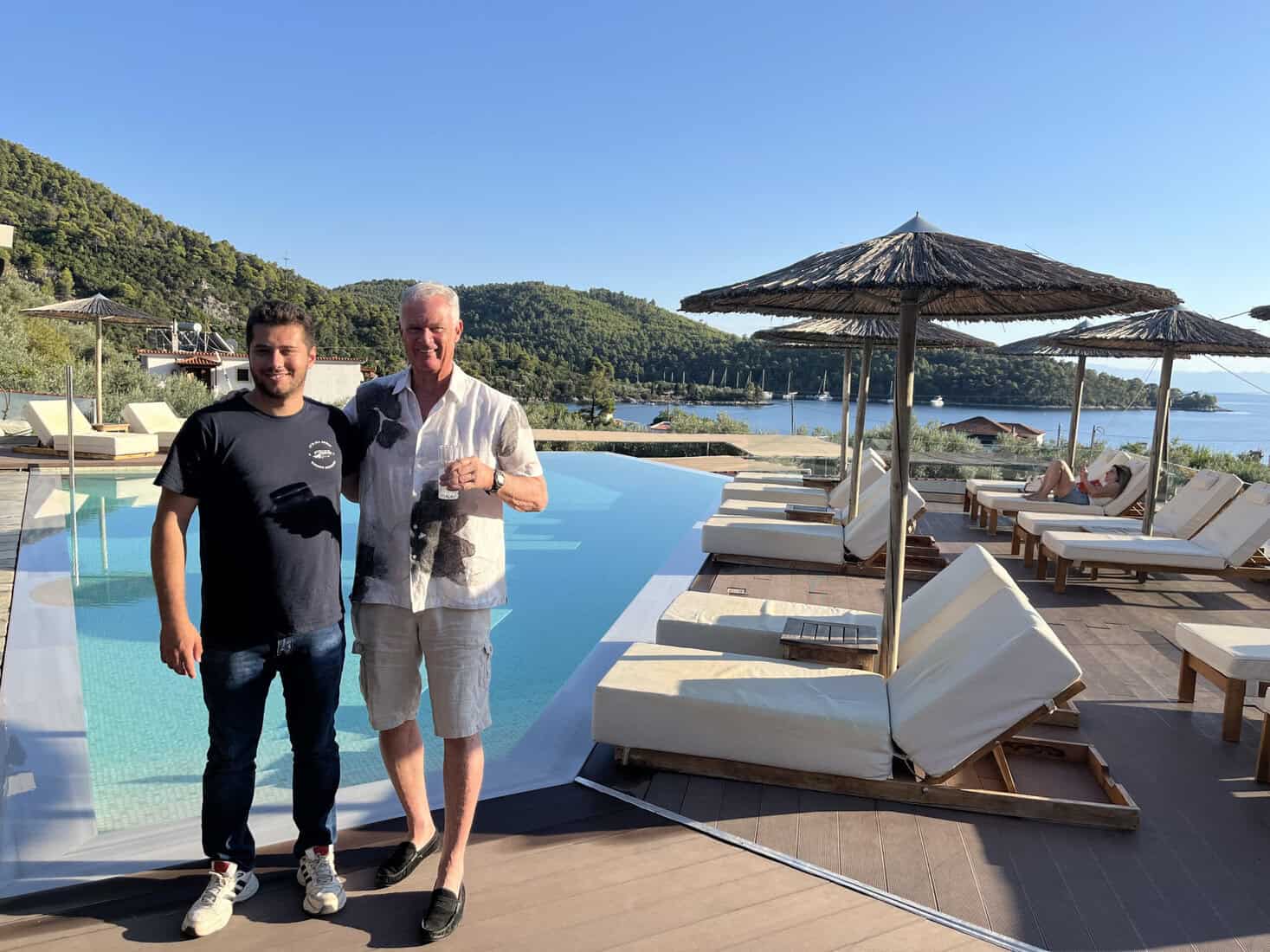
“The old ladies from the church, they used to say about the dragon and the protector of the island, Saint Riginos,” he said while putting more ice in my glass. “But the priests who were the officials of the church on this island, they say that it’s not confirmed about this story. There is a legend but there is no proven fact.”
You really think a dragon once existed here?
“Maybe before some years after Christ,” he said. “Maybe because of the climate change. Maybe there was a huge anaconda or something. For example, in Central Greece there were lions. At the moment we don’t have any lions because of the climate. So maybe the climate back then could support these animals and now can not.”
Angelos told of a story that centuries ago when Skopelos sailors left home, the wives would stop knitting. They thought making knots would make bad weather for the sailors.
We never found any dragons or ghosts of female pirates, but we will always return to Skopelos where the beaches, food and hospitality are legends in themselves.
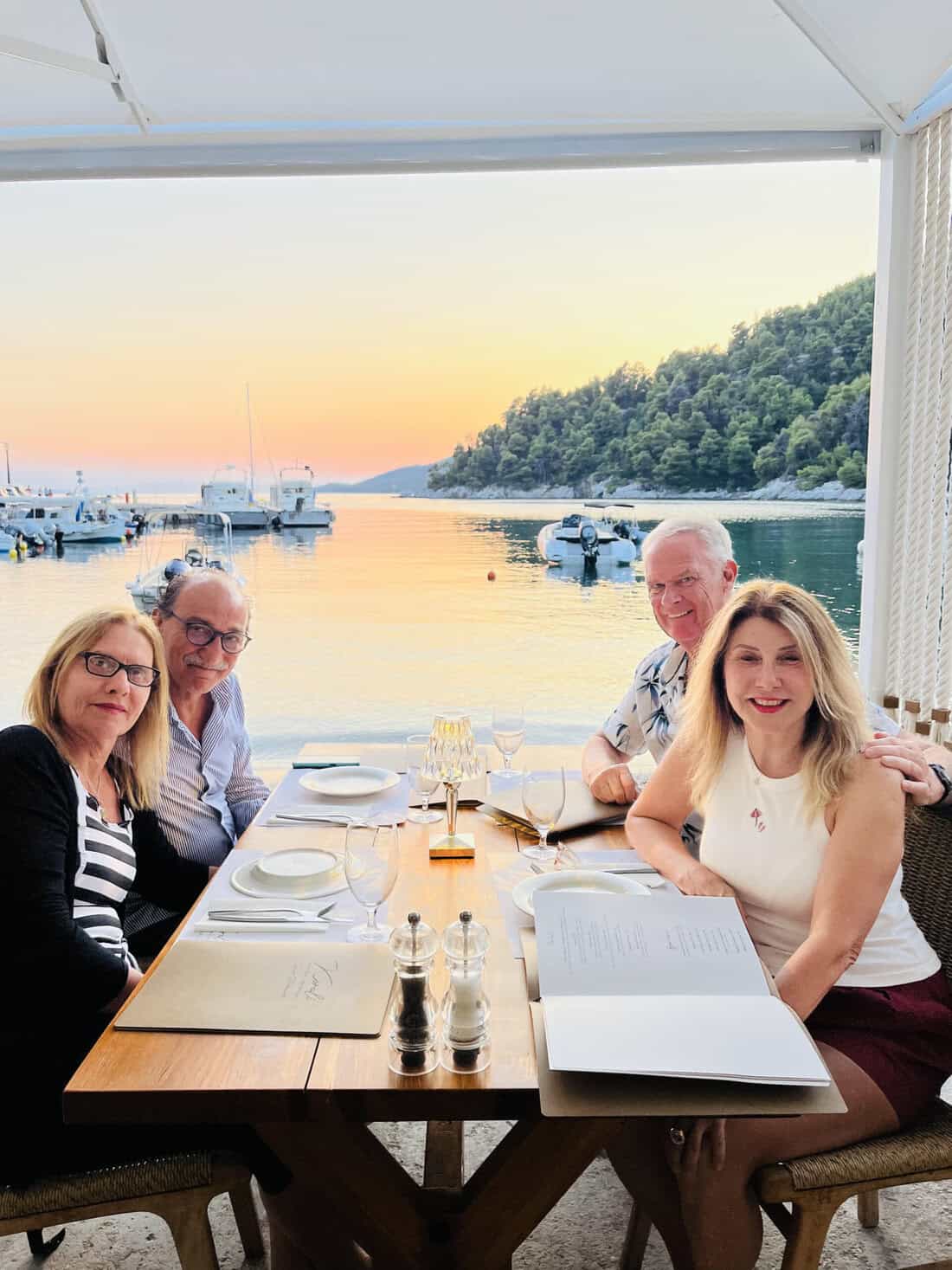
If you are thinking of going …
How to get there: Numerous cities in Europe fly directly to Skiathos, a 15-30-minute ferry ride from Skopelos. I paid €488 on RyanAir for two-round trip tickets from Rome, a two-hour flight. I paid €35 for two round-trip ferry tickets with Aegean Flying Dolphin.
Where to stay: Panormos Beach Hotel, 30-242-402-2711, https://www.panormosbeach.com, info@panormosbeach.com. We’ve stayed at Panormos Beach hotel five times and we’ll keep coming back. Located 100 meters up a narrow road from the beach, it has an infinity pool and poolside bar with lovely views of the sea. A hospitable, fun, helpful young staff can answer anything about the island. Double rooms start at €180 a night including a fantastic buffet breakfast.
Where to eat: Stafilos Restaurant, Stafylos village, 30-697-833-4099. Conveniently located right above Stafylos Beach with parking and a beautiful view of the sea, it features huge portions of Greek salads and souvlaki among other traditional Greek dishes. Dishes start at €13.
When to go: Weather is mild in the summer. Our week in July was high 70s and low 80s with low humidity. It was only slightly cooler in late-August and early-September when we usually go. Panormos has only 350 residents so it can only get so crowded.
For more information: Skopelos.com Local Guide, 30-21-0300-6009, https://skopelos.com.