


Rome fountains: My five favorites — and they’re free!
Living in the third-most visited city in Europe for 12 years, I’m used to crowds. Fortunately, I’ve been to every major tourist site in Rome multiple times. During the height of tourist season in July, I usually just stay in my air-conditioned flat and eat fruit.
After 2,000 years, however, the city of Rome, like a few other cities in Italy, has had enough, at least, in some places. On Feb. 2, the city started charging €2 to visit Trevi Fountain, Nicoli Salvi’s iconic 18th century baroque fountain made famous in 1960 when Anita Ekberg took a dip in La Dolce Vita.
You can still see the fountain from around Piazza di Trevi but for certain hours (11:30 a.m.-10 p.m. Monday and Friday, 9 a.m.-10 p.m. all other days), you must shell out to get to the fountain’s edge for that ubiquitous selfie. All other times it’s free.
The fee comes at the same time the city rolled out a €5 tourist ticket fee for some museums. They’re aimed to not only dissipate some bottlenecks but also generate an estimated €6.5 million a year.
That doesn’t count the estimated €1 million in coins collected annually from said tourists throwing them over their shoulder into the fountain, a long-standing tradition that means they will some day return to Rome.
I will always return to Rome but I’ve hesitated returning to Trevi Fountain. Last year during the Rome Jubilee the crowds around Trevi were worse than any city traffic jam.
I visited Monday and it wasn’t much different. I could barely walk at the back of the piazza. I had to squeeze my way through people just to reach the airport-style gate that separated the freeloaders from the paying customers next to the fountain down below.
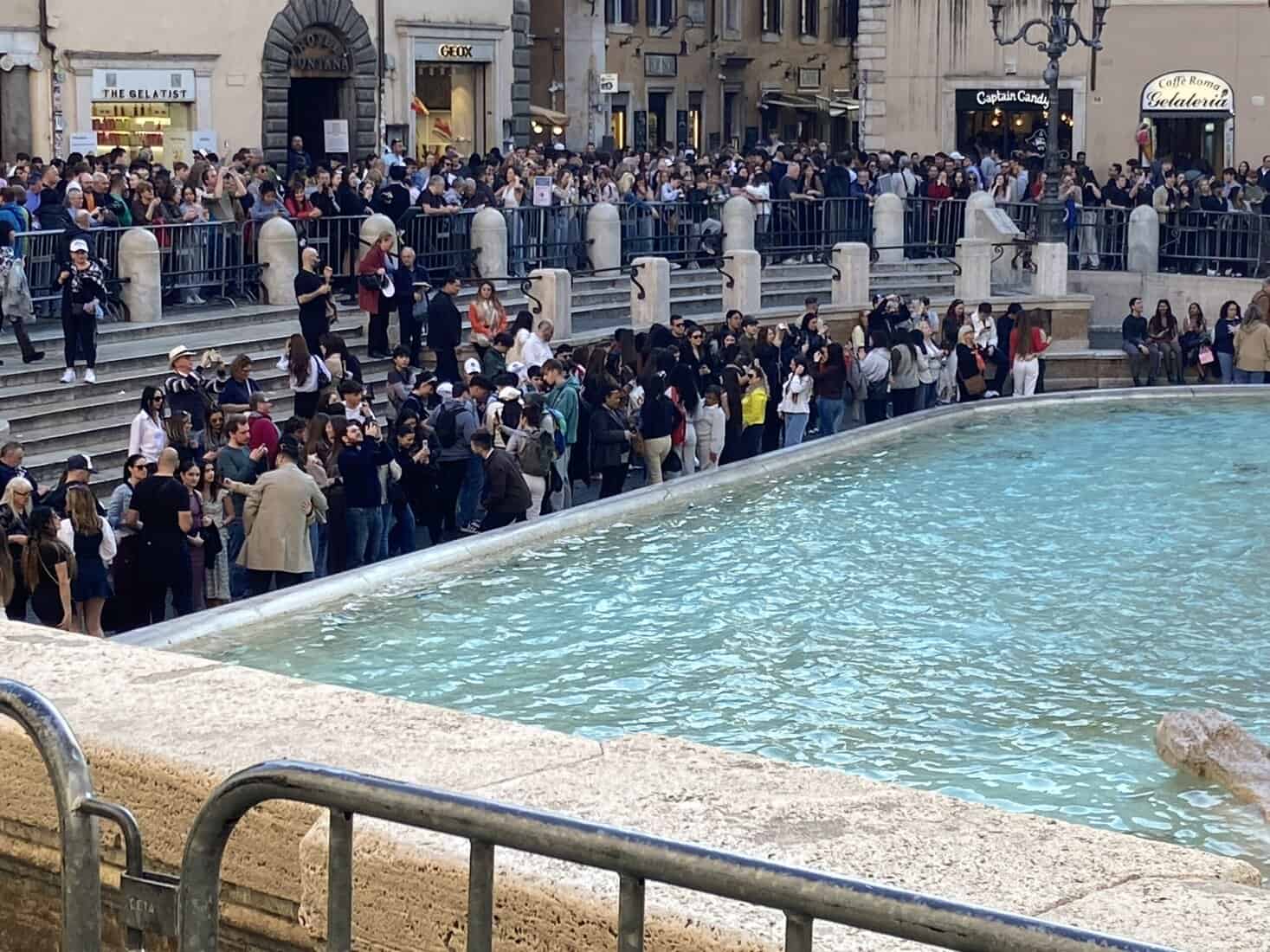
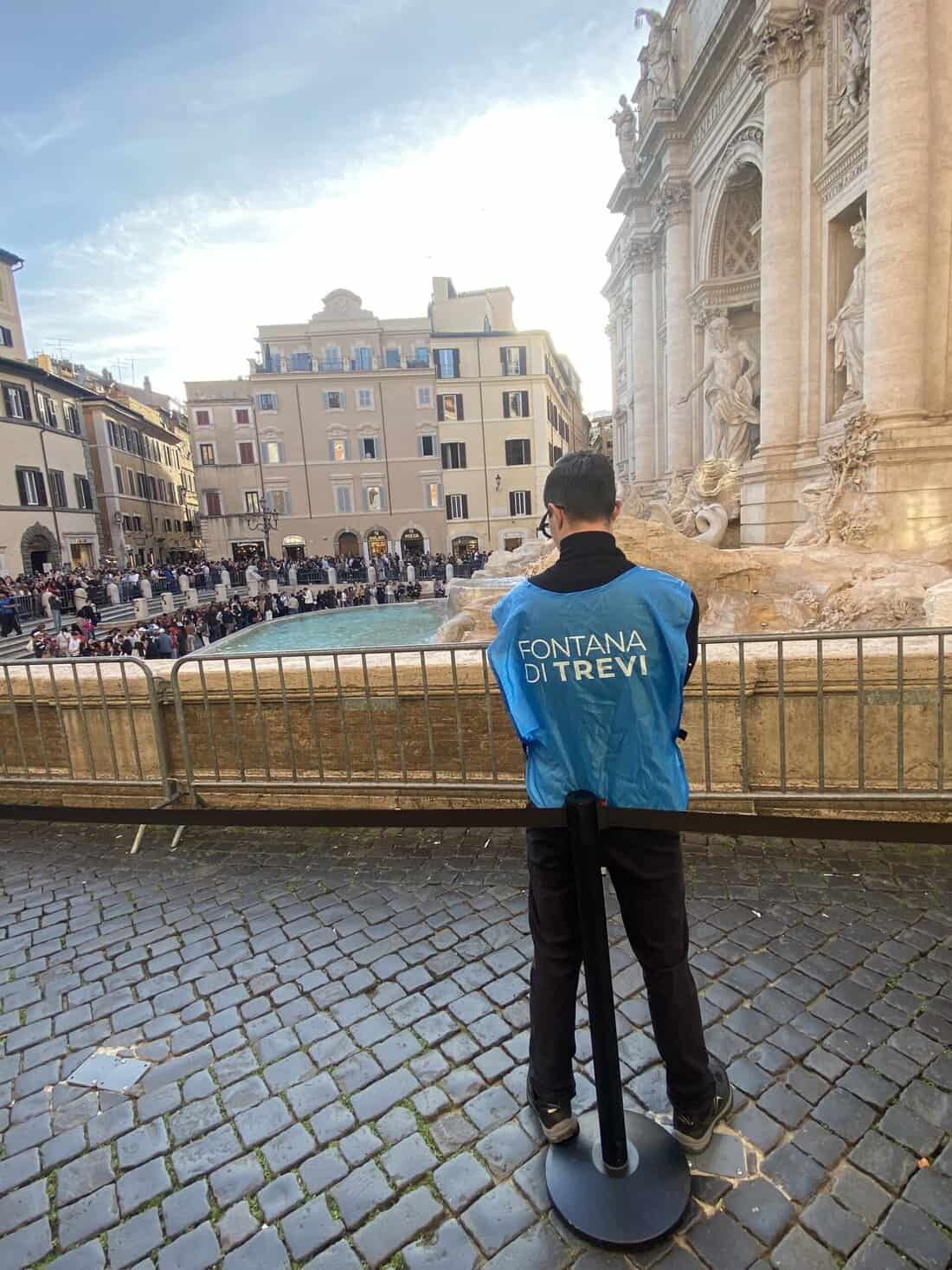
What was different were the two rows of lines and a ticket desk where people paid their €2. Numerous workers with blue “Frontana di Trevi” vests kept order. Down by the fountain’s rim, it was jammed cheek to cheek. It would be a challenge to get a selfie without someone else’s face or arm in the frame.
Fortunately, there are plenty of other fountains in Rome you can admire for nothing. In fact, Rome has an estimated 2,000 fountains, giving it the unofficial handle of the City of Fountains.
Rome’s fountain tradition dates back to the aqueducts. Ancient Rome was famous for its engineering and found ways to transport water from primarily the Apennine Mountains in the east to various areas of the city.
In the 8th century, the first fountain was built in Piazza di Santa Maria in Trastevere, a piazza less than two miles down the hill from my home.
In the 15th and 16th centuries, the popes wanted to transform Rome from a medieval city into a modern, glamorous metropolis that represented the church. In the 16th century, 18 fountains were built.
Many were mistaken for bathing areas and laws were put in place. The fountains remain to this day. They are the perfect place to examine the intricate artwork and hidden symbolism while sipping a glass of wine or caffè in a nearby bar.
It’s one of the simple pleasures of life in Rome. And here are my five favorite fountains, in order. The ranking includes the atmosphere and quality of the piazza where they sit. (Neighborhood in parentheses.)
Fontana dei Quattro Fiumi (Centro Storico)
Year: 1651.
Architect: Gian Lorenzo Bernini.
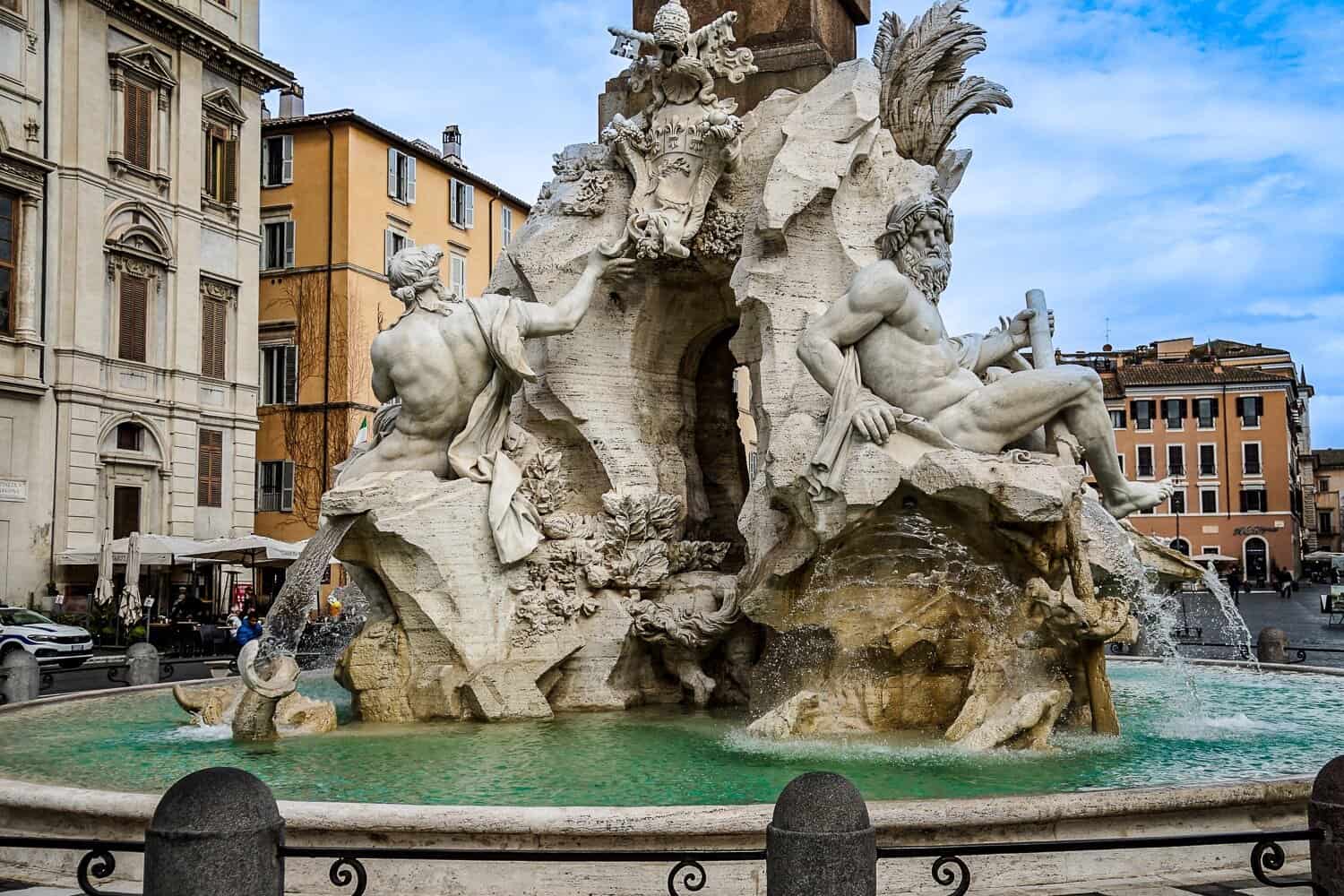
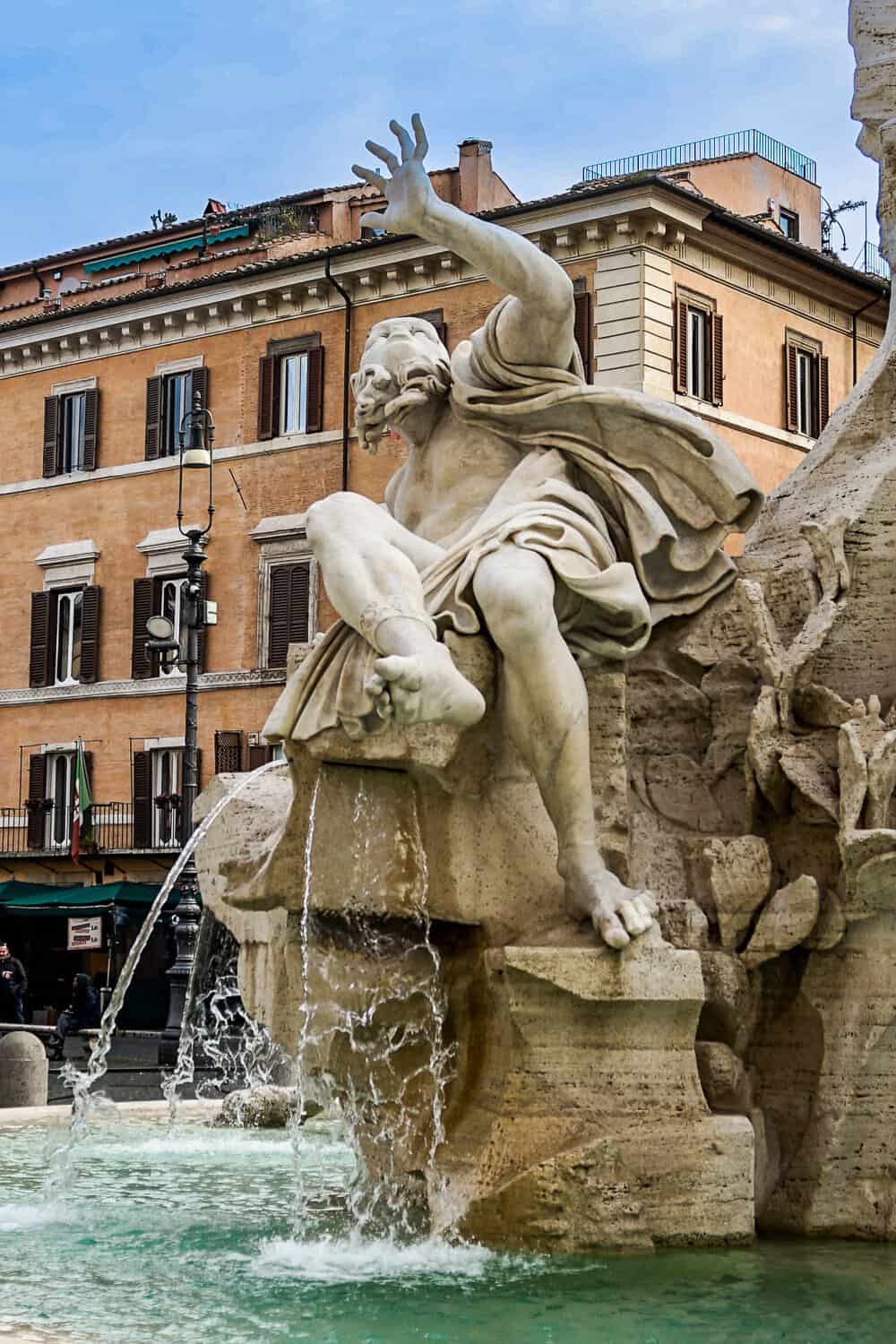
Description: Arguably the most spectacular fountain outside Trevi, it anchors the equally glorious Piazza Navona. Giant travertine rocks support statues of four river gods below an Egyptian obelisk topped by a dove with olive twigs. That’s the emblem of the Pamphili family whose palace it faces. The gods represent rivers on four continents and all carry a symbol: the Nile (Africa) with a loose piece of cloth over the eyes symbolizing that no one knew where the Nile source was, the Ganges (Asia) with a long oar to show it’s a navigable river, the Danube (Europe) with the god touching the papal coat of arms as the Danube is the closest river to Rome and the Rio de La Plates (Americas) with the god sitting on a pile of coins representing the riches the Americas could offer Europe.
History: New Pope Innocent X held a competition to design a fountain for Piazza Navona and excluded the famous Bernini. Pope Innocent had close ties to the powerful Pamphili family. Bernini was the favorite artist of Pope Urban VIII, Innocent’s predecessor who had ties to the Barberinis. Pope Innocent despised the Barberinis. Bernini was persuaded to enter a model anyway and had it secretly installed in Palazzo Pamphili he placed the model in a room where Pope Innocent had to pass. He loved it so much he awarded Bernini the commission.
Fun fact: Legend has it that the Plates river god has an open hand held out to nearby Chiesa di Sant’Agnese in Agone as if to shield his eyes. The church was designed by Bernini’s bitter rival, Francesco Borromini. In actuality, Bernini finished the fountain two years before Borromini started the church.
Where to eat: Terrazza Borromini. Via di Santa Maria dell’Anima 30, 391-311-4523, www.terrazzaborromini.com/ristorante, prenotazioniterrazze@gmail.com, noon-11 p.m., mains start at 35 euros. (Reservations valid only by phone after 11 a.m.) Located on the top floor of the 17th century Palazzo Borromini, it has the best rooftop view of Rome. Get an outside table on the edge to look down at Bernini’s fountain and order the grilled octopus appetizer.
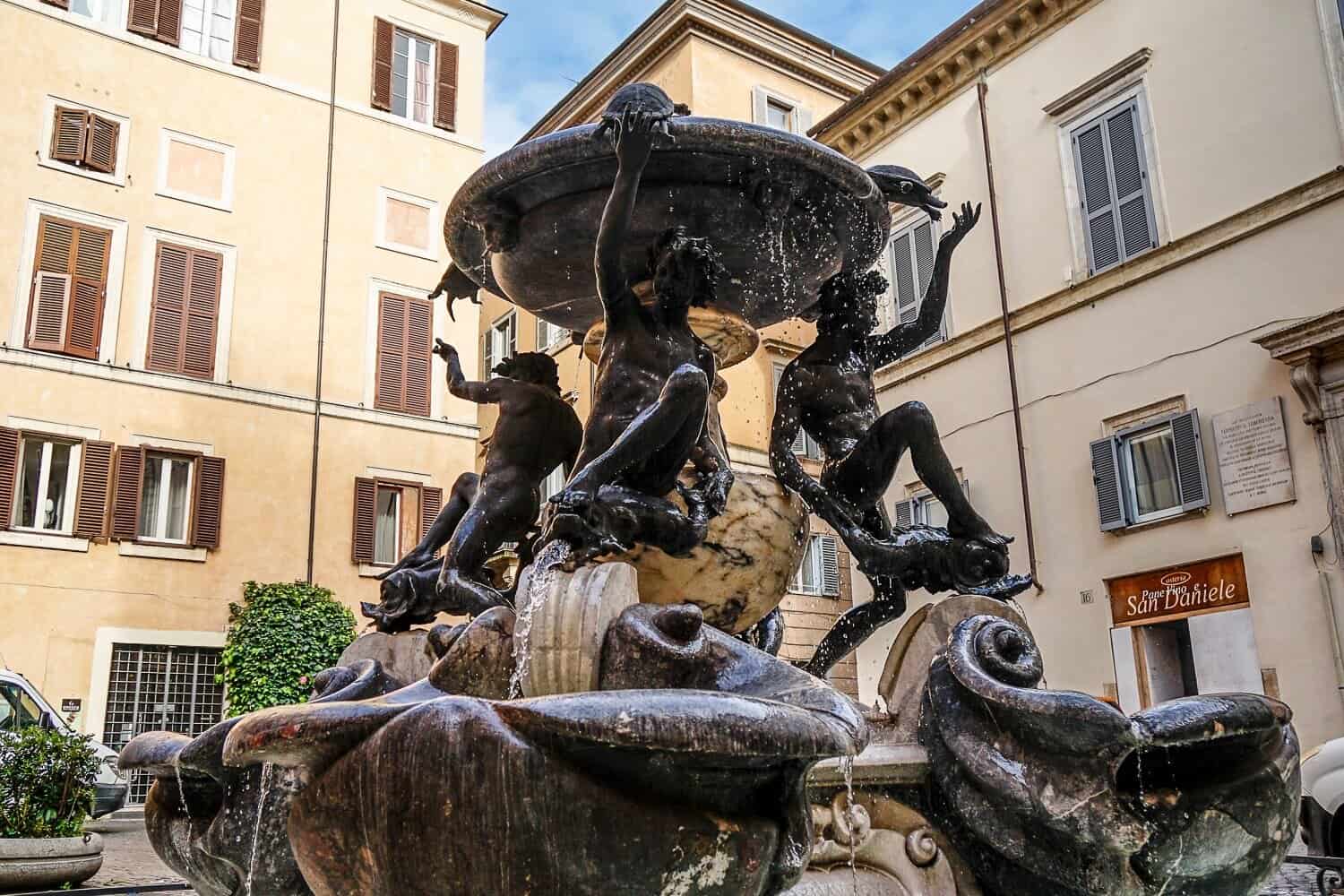
Fontane delle Tartarughe (Jewish Ghetto)
Year: 1588.
Architect: Giacomo della Porta.
Description: A giant African marble basin sits on a pedestal where water pours down the fountain. What makes it stand out are the different decorations featuring four young men, four dolphins and four bronze turtles. The men stand with one foot on a dolphin while reaching up to touch the turtle. The turtles represent wisdom, patience and prudence, valued characteristics during the Renaissance when the fountain was designed. In 1588 writer Girolamo Ferrucci called it “The most beautiful and perfect fountain in Rome.”
History: Originally, the men held up four dolphins whose mouths spewed water into the basin below. However, the water source came from nearby Piazza Navona which was only 23 feet higher than the fountain’s Piazza Mattei. The water pressure only produced a trickle of water. The dolphins were removed and, to give the men something to hold, they were replaced in 1659 with very realistic turtles. In 1853-54 during a puritan period in Rome, leaves were placed over the men’s genitals. The piazza was used in a scene from the 1999 film, The Talented Mr. Ripley.
Fun fact: Duke Mazio Mattei, a member of Rome’s powerful Mattei family and whose palace is on the piazza, faced heavy gambling debts and wanted to marry the daughter of a wealthy man. To impress the father, Mattei said he ordered the fountain built overnight. When the father saw the fountain, he allowed the marriage to go through. To remember the event, Mattei permanently closed the window in his palace facing the fountain. You can still see the window closed today.
Where to eat: Le Tartarughe, Piazza Mattei ⅞, 39-06-5987-1785, https://www.tartarughebar.it, 8:30 a.m.-midnight Sunday-Thursday, 8:30 a.m.-12:30 a.m. Friday-Saturday. Eclectic menu featuring hearty salads, creative appetizers such as hummus, pomegranate and sesame along with homemade pastas starting at 13 euros. Outdoor and indoor seating with great views of the fountain.
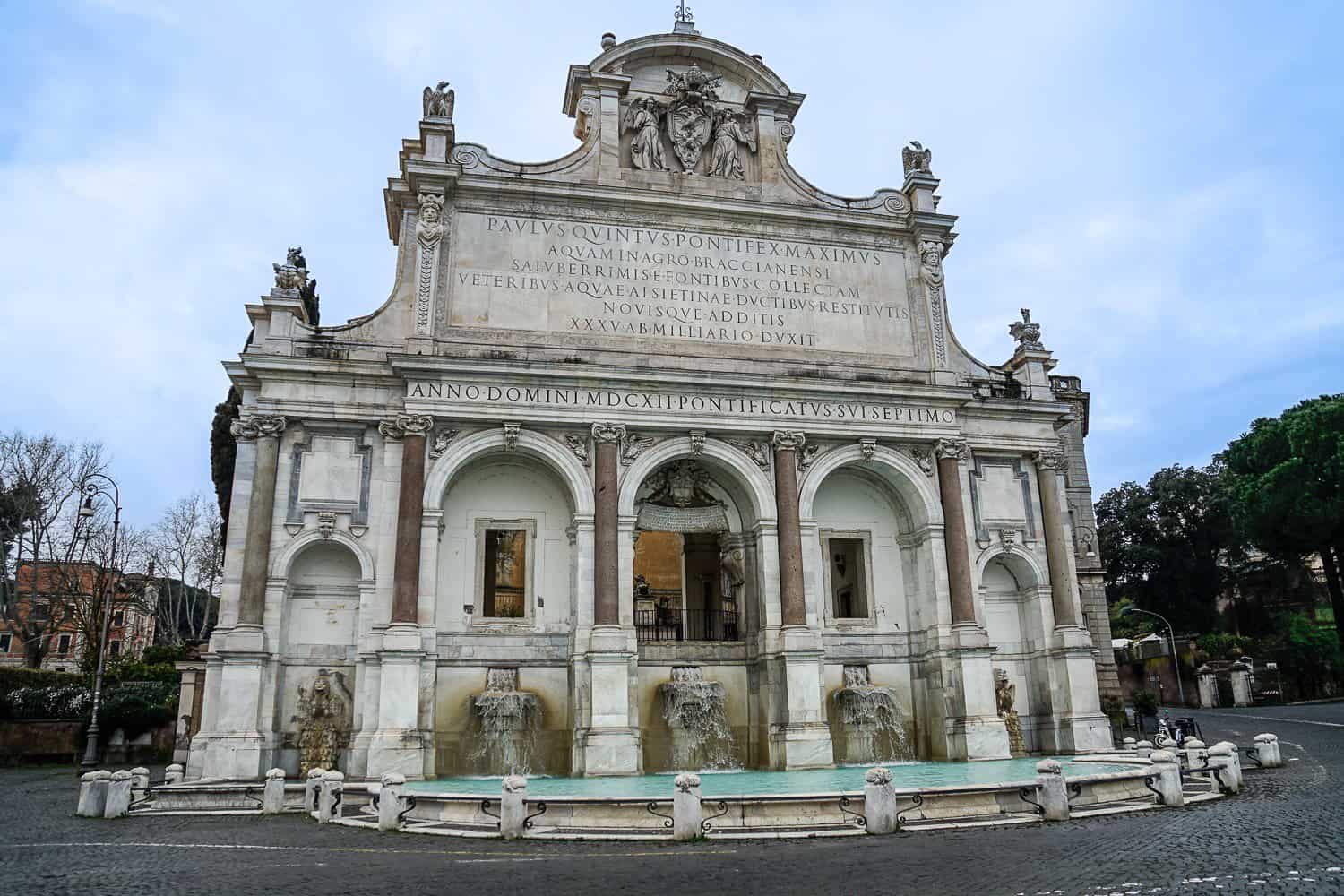
Fontana dell’Acqua Paola (Gianicolo Hill)
Year: 1612.
Architects: Giovanni Fontana and Flaminio Ponzio.
Description: The only reason it isn’t ranked higher than the Fontana delle Tartarughe is Acqua Paola has no tables and chairs. The fountain is a giant slab of white marble taken from the Temple of Minerva from the Nerva Forum. The lower part consists of three large arches and two smaller ones with streams pouring into a large semicircular pool of turquoise water. Six columns of red and gray granite come from St. Peter’s. The upper part consists of Latin inscriptions describing the construction. At the top is a papal tara and keys to St. Peter’s above an eagle and dragon, the symbol of the powerful Borghese family. While the fountain has no tables, across the street, Via Garibaldi, is one of the best views of Rome. Take a bottle of wine and sit along the wall.
History: It was built shortly after Pope Paul V restored the Trajan aqueduct in order to create drinking water for the locals who were taking water from the filthy Tiber River down the hill. The fountain was restored in 1859, 10 years after the French damaged it during their conquest of Rome. It is the set for the opening scene of The Great Beauty, the 2013 film that won the Oscar for Best Foreign Language Film.
Fun fact: To raise funds for the fountain, Pope Paul V put a tax on wine which enraged the population.
Where to eat: Scarpone, Via di S. Pancrazio 15, 06-581-4094, 12:45-3 p.m. 7:30-11:15 p.m. Tuesday-Sunday, www.ristorante scarpone.it. Just a 10-minute walk away, this restaurant which opened in 1849 features steaks and seafood pasta and a large garden dining area.
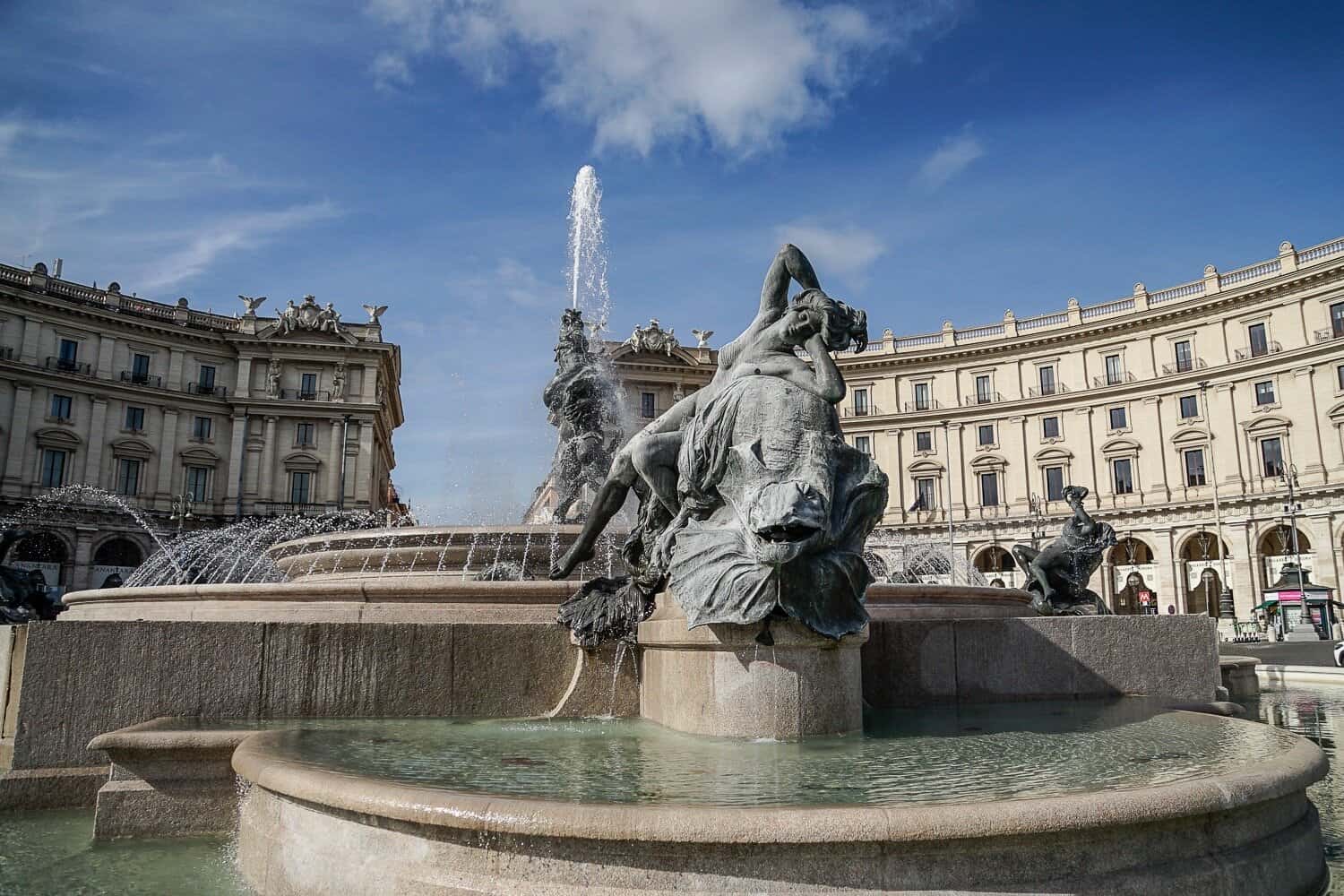
Fontana delle Naiadi (Esquilino)
Year: 1888.
Architect: Alessandro Guerrieri.
Description: Modern by Rome standards, the Art Nouveau Fontana delle Naiadi anchors the sprawling Piazza Repubblica where the glamorous Anantara Palazzo Naiadi Hotel hosts many red carpet Hollywood film promotions. It’s a giant concrete basin surrounded by bronze naiads or water nymphs. One nymph with a swan represents lakes, another with a river monster represents rivers, another with a wild horse represents oceans and one with a dragon represents ground water. The sea god Glaucus, added in 1912, holds a dolphin whose mouth shoots out the main source of water. Journalist Willy Pocino wrote it “is considered the most beautiful of Rome’s modern fountains.”
History: The original fountain was severely damaged by the invading Goths in the 6th century. Pope Pius IX wanted something monumental at the top of Via Nazionale. That one, built 70 meters from the current fountain, was a circular pool with five jets of water shot into the center. It was inaugurated in 1870 but in 1888, a city planning scheme forced the fountain to be moved a few meters. Using the opportunity to build from scratch, Alessandro Guerrieri built the current model. It originally had four lions but sculptor Mario Rutelli replaced them with naiads.
Fun fact: The nymphs’ buxom bodies were considered too risque for the church and a wooden fence was constructed around the fountain while awaiting for the city to rule on the protests. Eventually, the city ruled that the statues represented a progressive theme and took down the fence in 1901.
Where to eat: Dagnino, Via Vittorio Emanuele Orlando 75, 39-06-481-8660, https://www.dagnino.com, 7 a.m.-11 p.m. A taste of Sicily is in Palazzo Esedra next to Piazza Repubblica. Features Sicilian baked goods but specializes in Sicilian pastries. Eat in elegant surroundings that reek of old Italy.
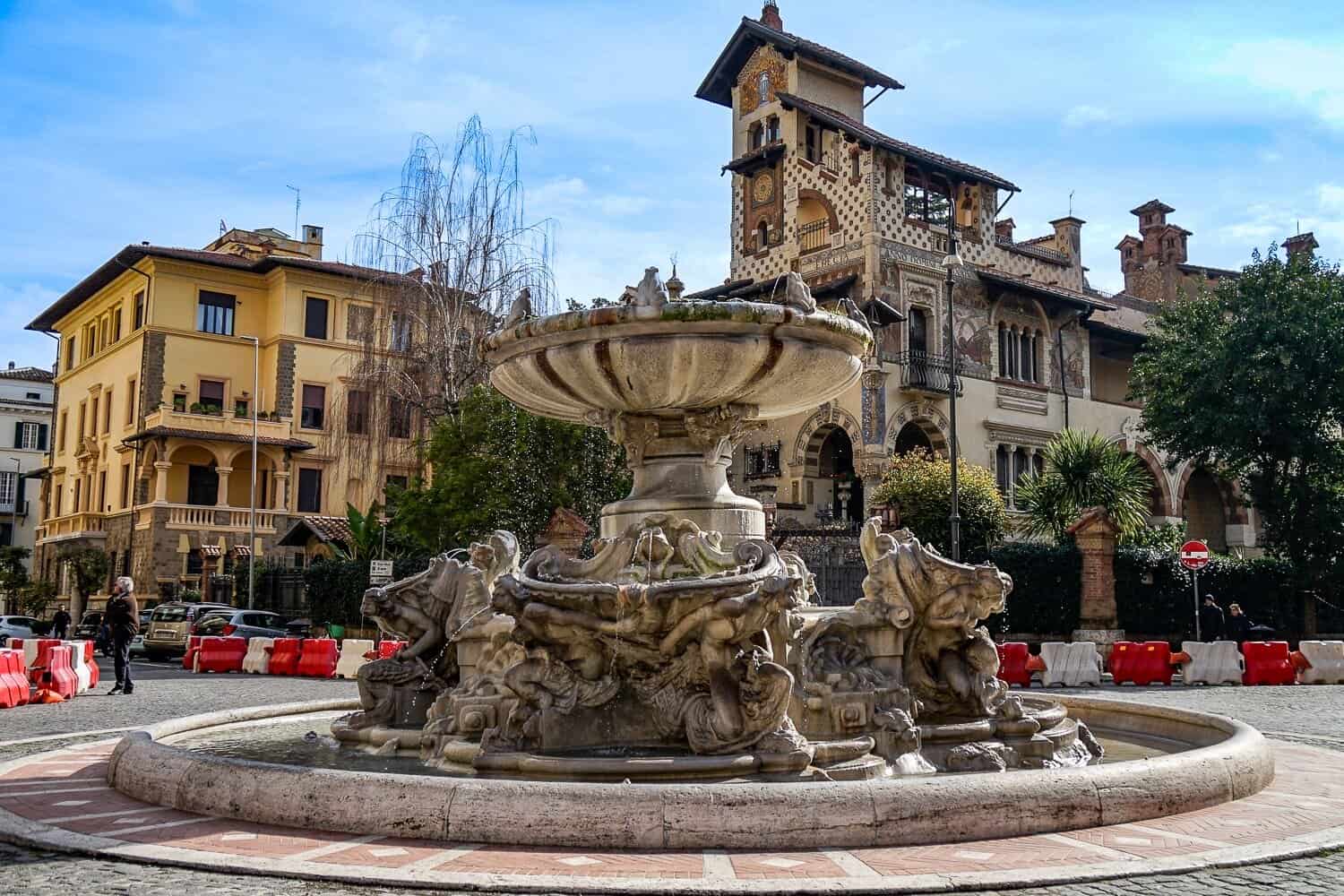
Fontana delle Rane (Trieste)
Year: 1924
Architect: Gino Coppedè.
Description: The “Frog Fountain” near pretty Villa Ada is in Neo-Baroque style with a four-lobe platform around a large basin. Each lobe is a basin atop the shoulder of two humans kneeling back to back. Water jets out of their mouths and mixes with water coming from a large frog. Eight small frogs are lined along the summit of the basin. A large bee on the edge of the basin is Coppedè’s tribute to Bernini.
History: The Florence-born Coppedè was a huge fan of Art Nouveau and in the 1920s set out to design a zone in the Trieste neighborhood. He built palaces and apartment buildings in a mix of medieval, Renaissance, baroque, Greek Classicism and Art Nouveau. Highlighting the zone is the fountain which pays homage to the Fontana delle Tartarughe built four centuries earlier.
Fun fact: It’s said that after performing at the nearby Piper Club in 1965, The Beatles took a bath in the fountain.
Where to eat: Capo Boi. Via Arno 86, 39-06-841-5535, 1-2:30 p.m., 8-11 p.m. Monday-Saturday. Just a block away from the fountain, its seafood is legendary with locals.
March 20, 2026 @ 7:51 pm
I’m not sure why, but this post makes me even more envious than usual.
The Trevi Fountain was under renovation, and hence dry, on my last trip to Rome. I stopped to look, but didn’t toss a coin.
Do you figure my coins from 1985 still count?
March 21, 2026 @ 9:26 am
Sure, that coin counts as long as you stay alive. Just don’t plan your next vacation in Iran which we are slowly bombing back to the Stone Age. I just cancelled Tuesday’s trip to the Maldive Islands. We were flying through Doha where they’ve cancelled about 5,000 flights and just got bombed on Thursday again. Our travel agency didn’t even bother waiting for our flight to cancel. They cancelled it for us. Marina’s relieved; I’m pissed. I can handle traveling through a war zone. I’ve been in the Raiders’ locker room after a loss.
March 24, 2026 @ 11:42 pm
Love all of these fontane. My favourite one in Rome is La Barcaccia. Something about it being a sinking ship is so endearing. I love drinking from it-the coldest water ever! Ciao, Cristina
March 25, 2026 @ 11:01 am
You drink out of that? Hope visiting soccer fans don’t pee in it.