


Three days on San Diego Bay aboard a catamaran
(Director’s note: Summer is over but in San Diego, sailing season is year round. Guest blogger Ethan Calloway explains how you can organize a catamaran trip around San Diego Bay for as long as three days.)
San Diego Bay rewards slow travel. The water is sheltered, the skyline stays close, and a boat with two hulls turns every cove into a floating living room. This walkthrough follows a long weekend built from sample itineraries a local charter company publishes, with notes on why each stop earns its place.
What do San Diego charters look like?
A captained San Diego charter with Blue Pacific Yachting is a catamaran trip that starts and ends at its Harbor Island base, with a licensed captain aboard and a route shaped around the group. Blue Pacific Yachting runs a sailing school alongside its catamaran charter business from bases in San Diego, Marina del Rey and Loreto, Mexico, and it keeps an all-catamaran fleet in San Diego. Every vessel carries a hard cap of 12 guests, so even the larger hulls feel like a private lodge on the water rather than a crowded party boat.
The formats are flexible. Blue Pacific Yachting’s San Diego service page, bluepacificyachting.com/san-diego-catamaran-charter, describes half day outings of four hours, full days of eight hours, and multi-day trips with a captain that run from one night to a week or more. The same page says captained charters need no sailing experience and can cover San Diego Bay, the ocean outside it, Mission Bay, Catalina or other points.
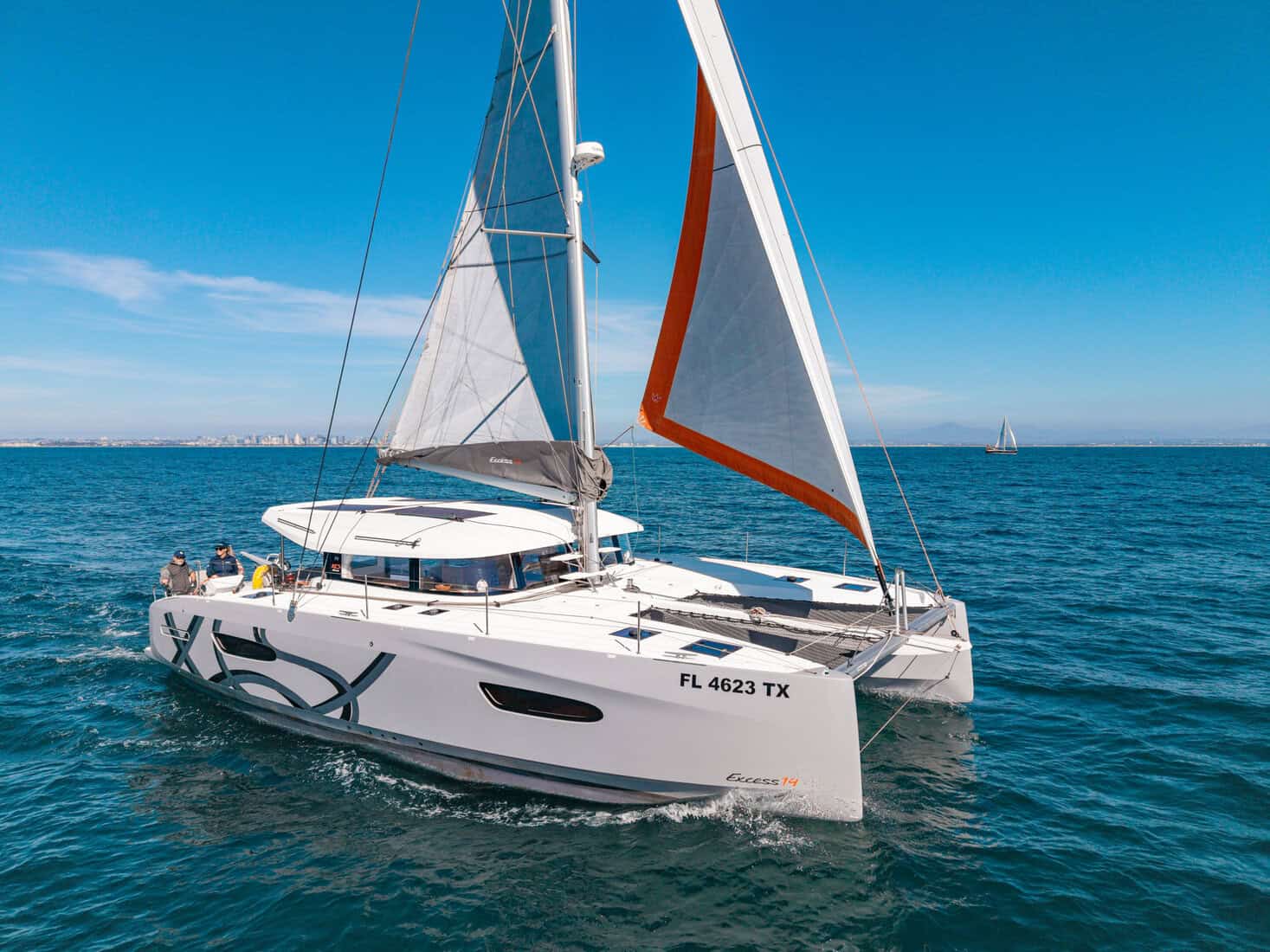
The San Diego fleet cards include the Lagoon 46 Blue Oceans, the Excess 14 Carte Sail and the Lagoon 42 Hopena, along with a Leopard 44 and a Fountaine Pajot Lucia 40. Different hulls suit different groups, so the choice of boat is part of planning the weekend.
Day One: Coronado
A catamaran anchors in Glorietta Bay at Coronado on the first night of the sample long weekend. The bay is a calm pocket on the Coronado side of San Diego Bay, with the city never far across the water. It makes an easy first night for a crew that is still finding its sea legs. Anchoring early leaves daylight for the group to settle into cabins, stow bags and get a feel for the boat.
Picture eight friends arriving on a Friday afternoon with coolers and no sailing background. Guests may bring their own food and drinks at no extra charge, or the company can coordinate catering or an onboard chef, so the first dinner can be a simple spread on deck or something more produced. San Diego is a year-round sunset-sail destination, and an evening at anchor in Glorietta Bay shows why.
Day Two: La Playa Cove
Day Two crosses the bay to La Playa Cove, tucked behind Shelter Island. The sample plan has guests take the dinghy to Fathom Bistro on the pier for dinner, and it notes that a Humphrey’s concert may be enjoyed from the dinghy when one is on. Arriving by small boat instead of by car is a small detail that makes the evening feel like a trip rather than an outing.
The cove also suits the slower rhythm of a catamaran. Wide decks give the group room to read, nap or watch the lights come on along the shoreline, and the two hulls keep the boat steady at anchor. Nobody has to hunt for parking or arrange a ride home, since the dinghy ride back to the boat is the last leg of the night. By the end of the second day, the clock has usually stopped mattering.
Day Three: What can you see?
A short ocean sail gives the group a chance to look for whales and dolphins. The final day heads outside the bay, where sightings are never guaranteed, which is part of the appeal of going to look. Guests who tend toward seasickness can skip this leg and stay inside the bay, a tip the service page offers for exactly that situation.
Outside the bay the swell is longer and the horizon opens up, so the pace changes. The sail stays short and unhurried, leaving time for everyone to take a turn at the rail watching the water for a spout or a fin.
From there the route curls back toward Harbor Island and the home base at Safe Harbor Sunroad, closing a loop that never strays far from the city. Catamarans also tend to sail flatter than single-hulled boats, which helps on a day with more motion. Three days, three very different bodies of water, and not one long transit.
Do you need sailing experience?
No. Captained charters in San Diego require no sailing experience, so a group like the one in this walkthrough can leave the helm to a licensed captain. The company’s captains hold USCG 50-Ton and 100-Ton Master licenses, and its instructors are ASA-certified.
Those who want to steer eventually can climb the ladder set by the American Sailing Association (ASA), founded in 1983 and used by U.S. sailing schools: ASA 101 Basic Keelboat Sailing, ASA 103 Basic Coastal Cruising, ASA 104 Bareboat Cruising and ASA 114 Cruising Catamaran. San Diego bareboat charters accept ASA 114 certification, and anyone without prior bareboat catamaran experience hires a licensed captain for supplemental training at the start of the first charter.
For people who would rather learn than lounge, Blue Pacific Yachting teaches out of San Diego as well. The path starts on Capri 22 basic keelboats and leads to a five-day all-inclusive liveaboard class to Catalina Island for ASA 103, 104 and 114, which is the company’s most popular offering. It is a different kind of trip from this weekend, built around coursework rather than coves.
Planning the weekend
As of fall 2026, summer’s standout stretch (June to November) is winding down, but the bay stays a year-round sunset-sail destination, and San Diego Bay and Mission Bay both offer multiple anchorages for overnight stays. Below you can compare the stops from the sample itinerary with the Mission Bay alternative.
Day 1 – Glorietta Bay, Coronado: A calm anchorage that gives everyone time to settle in, unpack and get comfortable aboard the catamaran.
– Day 2 – La Playa Cove, Shelter Island: A sheltered spot ideal for an evening ashore, with dinner at Fathom Bistro accessible by dinghy.
– Day 3 – Ocean outside the bay: An open-water sail with opportunities to look for whales and dolphins, although sightings are not guaranteed.
– Alternative – Mariner’s Cove, Mission Bay: Located about nine miles north of the main route, this stop offers a different setting with more opportunities for beach time and water activities.
The Mission Bay version of the weekend sails about nine miles north to Mariner’s Cove. Mission Bay Park is commonly described as the largest man-made aquatic park in the United States, which makes it a natural fit for groups with kids, since the service page suggests planning water play and beach time for them. Those with more time can stretch the idea into a weeklong coast hop to Catalina, whose two main harbors for visiting boats are Avalon and Two Harbors, also called the Isthmus.
A few planning notes from the itineraries and the local calendar:
- With kids, plan water play and beach time, and let the youngest guests pick the afternoon swim stop.
- With seasickness-prone guests, stay inside the bay and skip the ocean leg.
- Schedule the charter around a San Diego festival, conference or concert so the boat becomes the base for the event.
- In December, the annual San Diego Bay Parade of Lights, a boat parade on the bay, is worth building a trip around.
- On a Saturday morning, stop by the Tuna Harbor Dockside Market on the San Diego Embarcadero, where local commercial boats sell their catch directly to shoppers, and pick up seafood for dinner aboard.
Last look at the bay
A long weekend on San Diego Bay by catamaran comes down to a simple pattern: one calm anchorage, one evening ashore by dinghy and one morning looking for whales and dolphins. Each stop is short, the boat is the hotel and the city is never far away. That mix of shelter and open water is a good way to see the bay from the inside.