


La Campana: Rome’s oldest restaurant still drawing crowds after 508 years
When La Campana opened its doors to the hungry public in Rome, Michelangelo was working on the Sistine Chapel. The Ottoman Empire had just expanded to Syria and Egypt. The most advanced city in the Western Hemisphere was Tenochtitlon in Mexico.
The world had no electricity or central heating. Most people were farmers. Religion was the dominant power and Charles V was about to rule the Holy Roman Empire.
That was 1518.
It’s half a millennium later and La Campana is still feeding the hungry in Rome. It’s in the same location on the same alley in Centro Storico. It still has the same strong reputation among locals and visitors alike.
After emerging during the height of the Italian Renaissance, La Campana has made a name for itself besides consistent fare that has lasted more than 500 years.
It lays claim to the title of the Oldest Restaurant in Rome.
In fact, it should probably be called the Oldest Restaurant in the World. The Guinness Book of World Records lists Botin in Madrid. Opened in 1725, Botin, in comparison, is a big food truck with better tapas. Guinness, however, requires better documentation to prove an “uninterrupted operation” although Botin’s documentation has some inconsistencies.
Most recently, La Campana has been in the same Trancassini family for 100 years. They’ve talked to Guinness but aren’t pursuing it terribly hard.
“If you put too much attention on the history of the restaurant and try to fight for the Guinness and nothing else, you can become a tourist trap,” co-owner Paolo Trancassini said.
La Campana is not a tourist trap. The food is too good. Paolo said his clientele is about 50 percent tourists and 50 percent Romans from all over the city.
Marina and I are among the locals.
The arrival
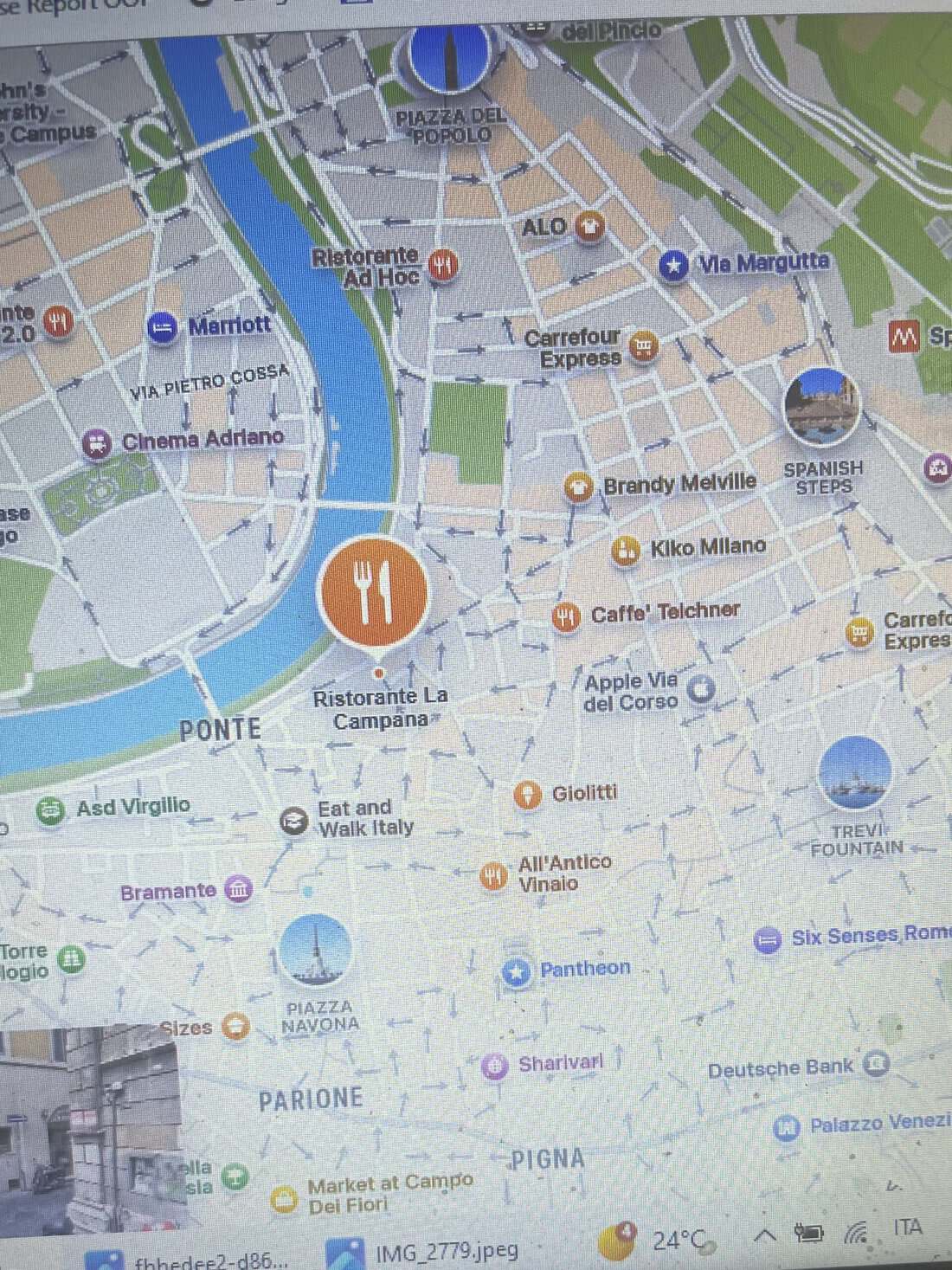
Saturday night, Marina and I went for the second time. La Campana sits inconspicuously at the end of an alley, still named Vicolo della Campana, two blocks from the Tiber River. Piazza Navona, one of the few structures around when La Campana opened, is half a kilometer to the south.
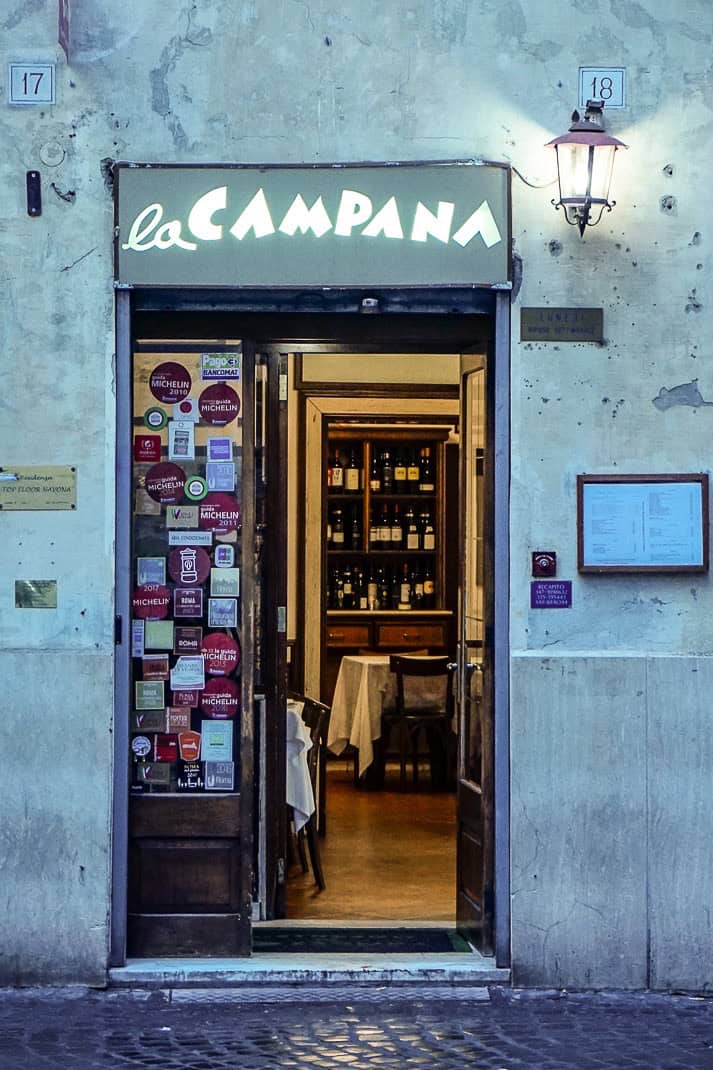
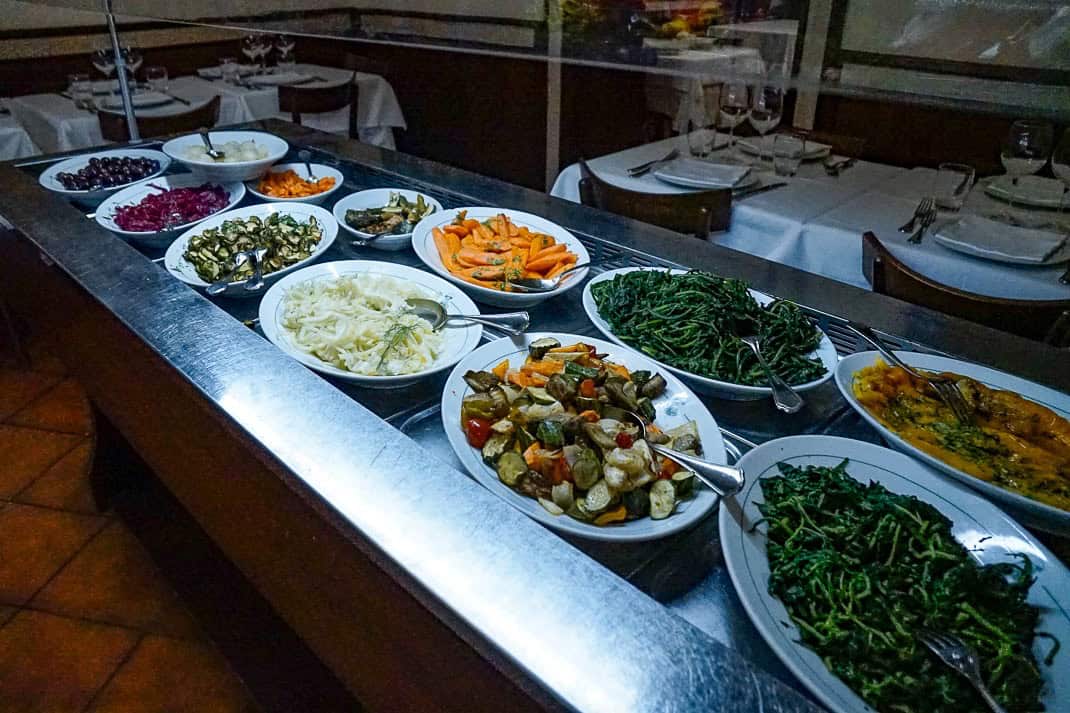
We walked through the small door under a La Campana sign that looked almost hand painted. Inside is simple elegance: white tablecloths and white walls with veteran waiters scurrying around in white shirts, black vests and ties.
The walls are adorned with lithographs of Rome landmarks from the distant past.
Unlike many famous Rome restaurants, there are no photos of the many celebrities who’ve dined there such as Goethe, Picasso, Guttuso, Pasolini, Sordi and Fellini. Then again, the camera hadn’t been invented when it hosted Caravaggio.
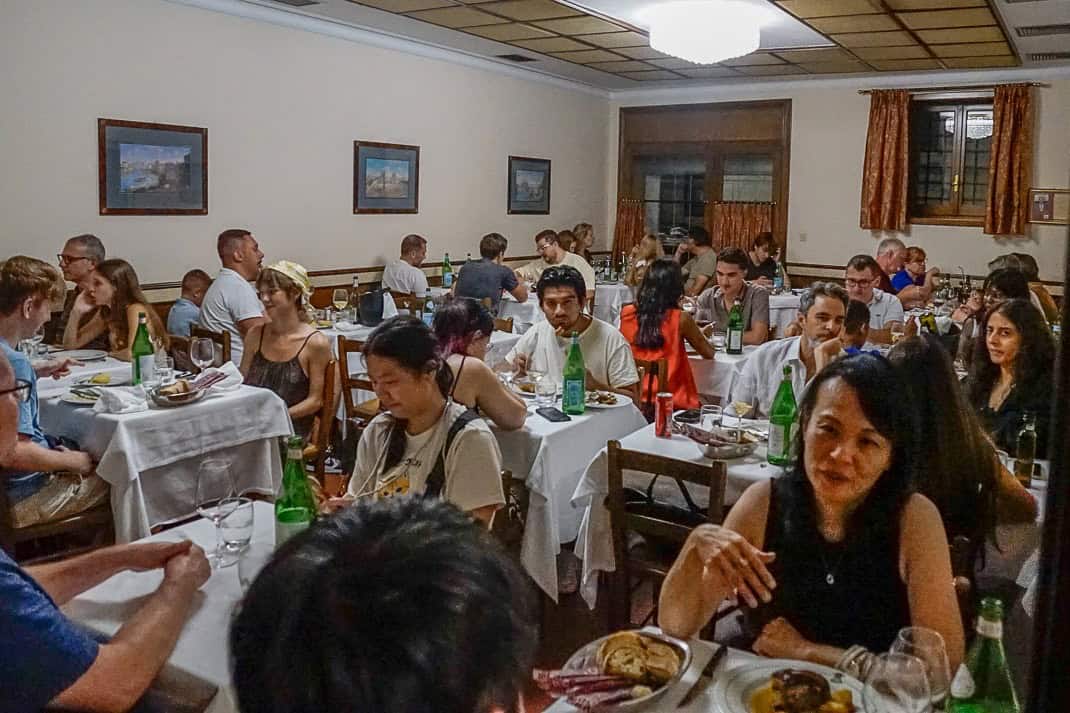
At 7:30 p.m., we were the second couple to arrive. Within an hour it had nearly filled. I saw one table of Asians. I heard some English. But most of the diners were Italian. The simple two-page menu was only in Italian.
That’s a good sign. I’ve seen some Rome tourist traps with menus in Uzbek.
La Campana is a classic Roman restaurant with classic Roman dishes: Rigatoni alla carbonara. Tonnarelli cacio e pepe. Trippa alla romana.
We started with one of my favorite hot-weather dishes: prosciutto e melone. The prosciutto was so lean and the perfect bed for a healthy slice of cantaloupe served chilled.
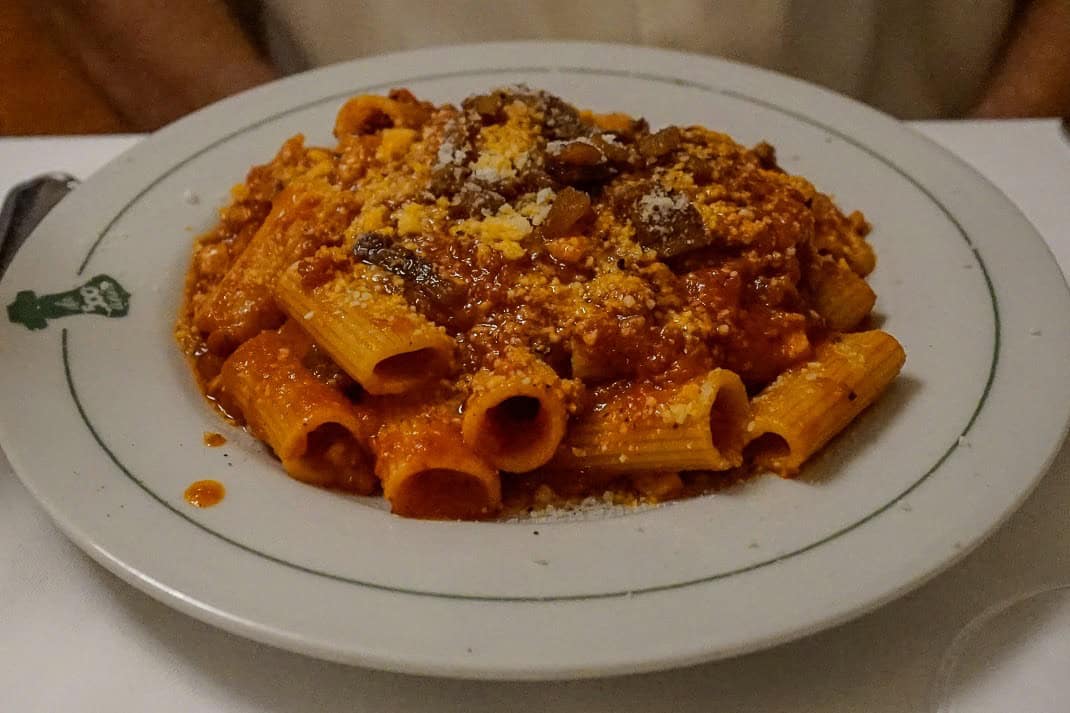
I ordered my favorite Italian dish, the one I measure for all Roman restaurants: rigatoni all’amatriciana. The guanciale (pig’s cheek) was so crispy with no fat. The pasta was fresh. They didn’t bury it with parmesan.
Marina’s spigola (swordfish) was fresh right out of the sea. She loved it. From a lifetime Roman and seafood lover, that’s as good a compliment as a Rome restaurant could get. With a couple glasses of local Cesanese wine, I paid €60.
In Rome, with post-Covid restaurant inflation, that’s a bargain.
La Campana history
Five hundred years ago right where we sat, La Campana served travelers who came through Rome on pilgrimages. La Campana was known as a locanda, a place where travelers could find food and lodging. It served as a postal station. It helped travelers with transport. Horses could rest and replenish.
Back in 1518, La Campana was the brainchild of Pietro della Campana, who had seven mouths to feed in his family. A property census from 1526 said he paid six scudi to open the inn. The price of a cheap home in early 1500s Rome was about 12 scudi.
What did they serve back then? Certainly not amatriciana. Tomaso Garzoni wrote in his epic 16th century occupation encyclopedia, Piazza Universale di tutte le pressioni del mondo, in 1585:
“As soon as you arrive at the inn, the innkeepers promise you good bread, good wine—perfect Trebbiano, musky Greco, excellent Vernaccia, superb Ribolla, exquisite Malvasia, Moscatello, Romani, wines from Cesena, Monteferrato, and Piedmont, sweet wines, tart wines, and zesty wines—along with roast meat, boiled meat, potacchio stew, tarts, and ravioli.”
This locanda, one of many in Rome at the time, continued into the 19th century and it is the only one remaining today.
The owners
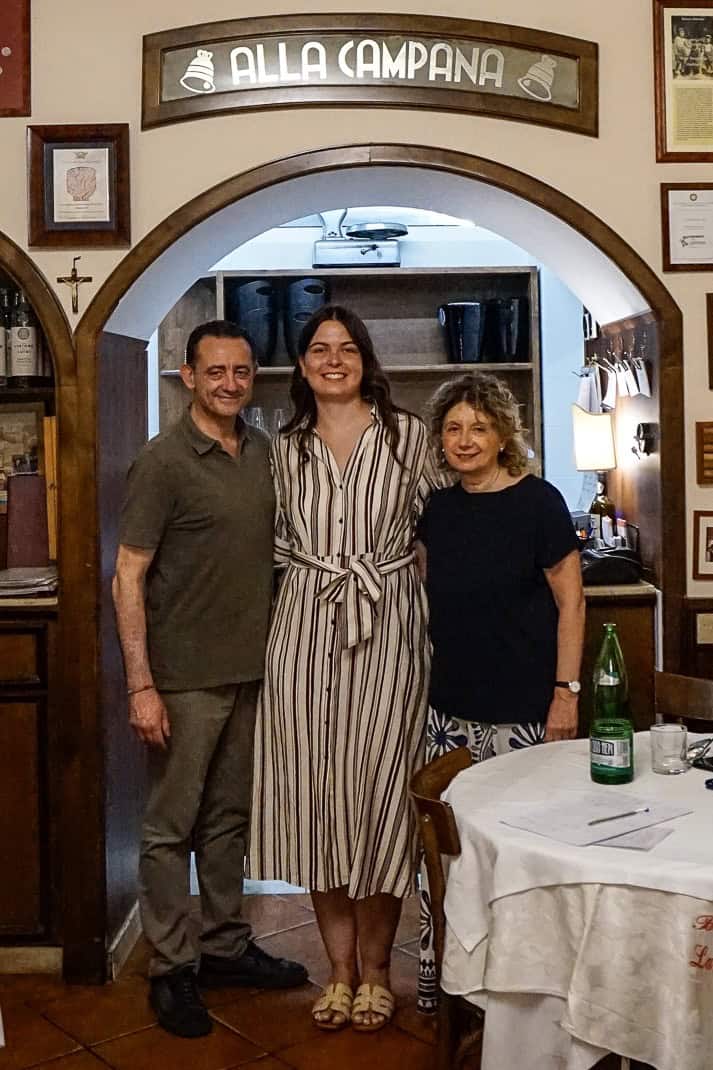
After dinner, Paolo, his sister and co-owner Marina and Paolo’s daughter, Alicja, came to our table and talked about the passion their family has had for more than a century.
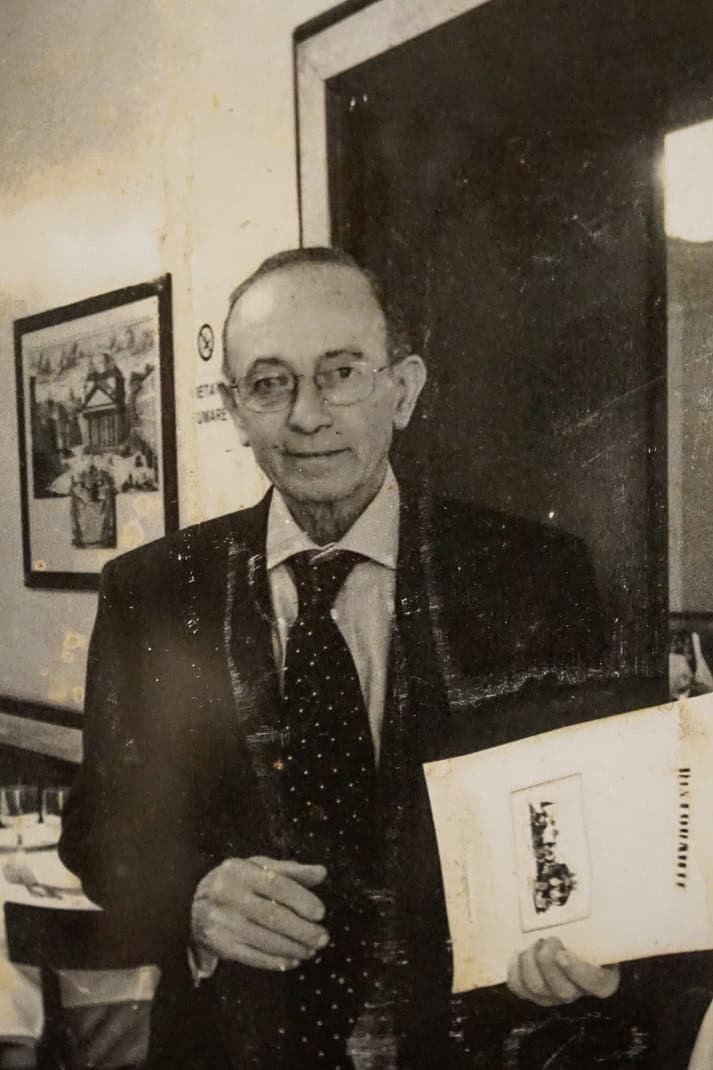
The Trancassini and Jacobini families, originally from the tiny town of Leonessa, about 60 miles (115 kilometers) north of Rome, took over the locanda in the early 20th century. Pictures hang on the wall of Pasquale Jacobini from the 1800s. Another grainy black and white shot from 1937 shows Paolo’s father, Giuseppe, when he was 4 years old outside the restaurant.
Paolo doesn’t look like a man who’s weathered the competitive Rome restaurant storms his whole adult life. Fit and always smiling, his hair showing nary a trace of gray, he belies his 63 years.
He and Marina said they try to maintain the tradition that began back in the early 1500s.
“You must maintain the restaurant even though the world is changing,” Marina said. “It’s a challenge but everyone tries to go fast. We want to be like a family house. You come to Sunday lunch like at home, with your friends.
“Come with us. Stay with us.”
To celebrate their 500-year anniversary in 2018, they hosted a big party for all their regular customers. They produced a pretty 40-page booklet detailing its history called La Campana which they presented to Guinness as further documentation.
Nothing in the restaurant is original except the plot of land. They have romantic outdoor seating not far from the mob of tourists who pour through Centro Storico every night.
After our chat, we walked out into the night, still steaming from another Rome summer heatwave. The nightclub Party Monster was across the street. A Carrefour supermarket was around the corner.
Caravaggio and Goethe wouldn’t recognize today’s Rome. But they’d find one bit of home-cooked comfort that has been in the same alley for 508 years.
Info: Vicolo della Campana, 18. 39-06-687-7273/39-347-109-8632, https://ristorante-la-campana.placejoys.com, ristorantecampana@gmail.com, 12:45-3 p.m., 7:30-11 p.m. Tuesday-Sunday.
August 11, 2026 @ 4:10 pm
Do you record interviews like this one, or take notes? And if you take notes during an interview conducted in Italian, are your notes in Italian, or English?
(Or Uzbek?)
Love this story, and I want to visit this place.
August 12, 2026 @ 11:11 am
I record all my Italian interviews. I translate them afterward. That goes against my upbringing. I always took notes while recording interviews in case my recorder screwed up. But with Italian it’s just too difficult to take notes. Next time you come to town, we’ll go. What’s new with you?
August 12, 2026 @ 7:00 am
Love Marina’s photos.
August 12, 2026 @ 11:05 am
Thanks, Tom. So do I. I’ll tell her that.
August 13, 2026 @ 6:22 pm
Ciao John…you forgot to specify that Paolo Trancassini is also, since 2018, a Member of Parliament, elected to the Chamber of Deputies with Fratelli d’Italia